SAN FRANCISCO — The paper appeared out of nowhere.
It was 1997, and Boog Sciambi was in his first year as a big-league broadcaster with the Florida Marlins. The night was cold, frigid, and featured those signature Candlestick Park winds. Out of nowhere, small pieces of ripped-up paper flew into Sciambi’s booth. The origin? The best friends in the next booth over, who took the stat packs, tore them up and threw them out of their window.
Read more Endorsement: Elect Fiona Ma California’s lieutenant governor
“Looking to the right, Kruk and Kuip are just giggling,” Sciambi said. “They would just be falling over themselves, laughing.”
The moment was quintessential Duane Kuiper and Mike Krukow, one of an infinite number of vignettes that encapsulated the youthful spirit they never lost, the unparalleled chemistry they forged, the unbreakable friendship they’ve shared.
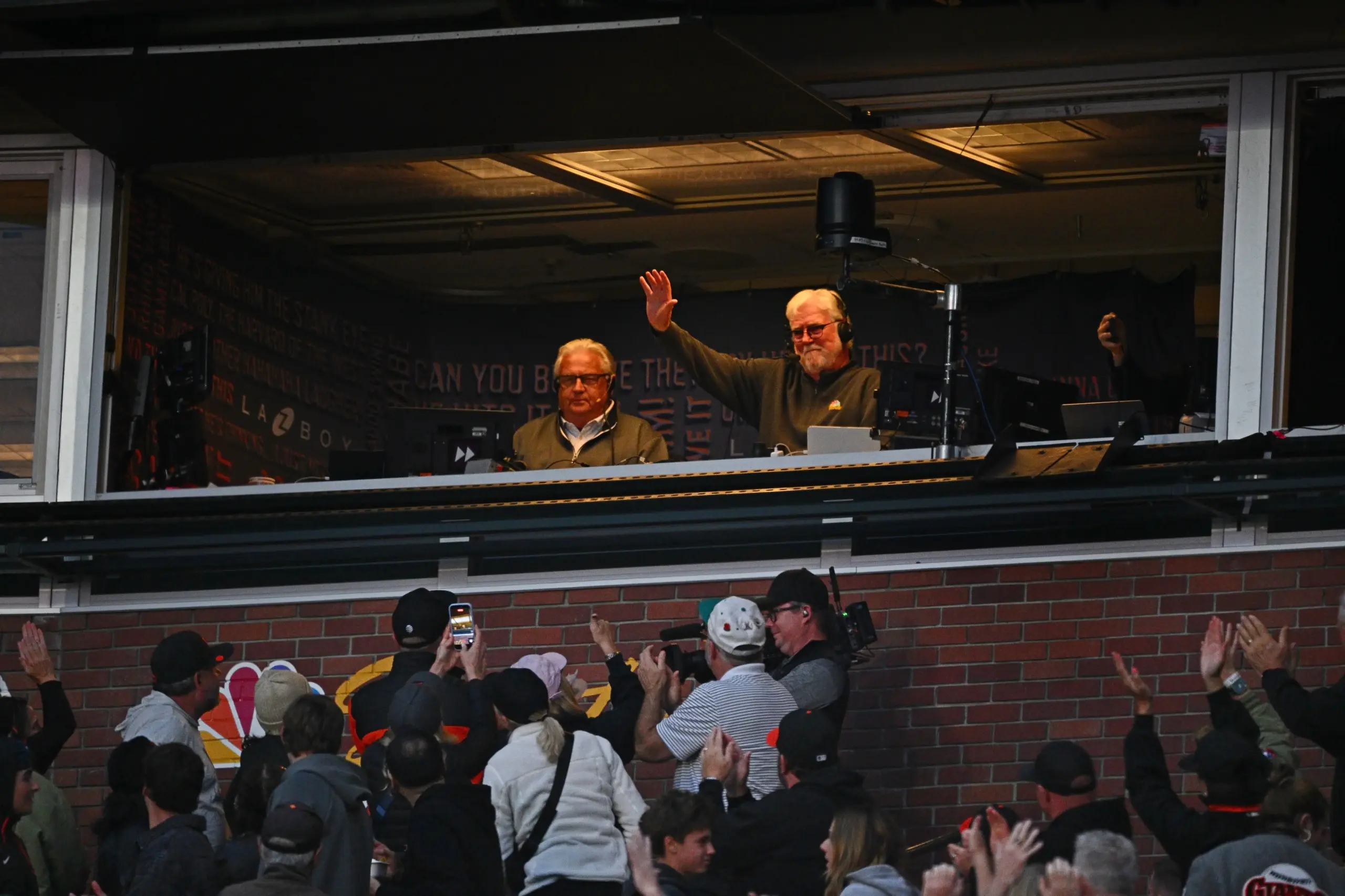
Krukow’s impending retirement, one brought about by a two-decade-long battle with inclusion-body myositis, doesn’t just mark the end of his brilliant 36-year broadcasting career, but the end of Kruk and Kuip on the airwaves. This final weekend has lined up to be an emotional affair, but even more so with Kuiper announcing last Sunday that he is battling throat cancer.
Sunday’s season finale will mark the end of an era — for the Giants and for baseball. And for the fellow broadcasters like Sciambi, among so many others, who entered their orbit, Kruk and Kuip’s impact on the game will endure well beyond their times behind a microphone.
“From day one, I think they kind of changed the game, honestly, with how we interact with each other,” said Brian Anderson, who currently broadcasts for the Milwaukee Brewers and TNT. “My generation will certainly try to pass that along, but those guys were a lot cooler than anybody who was doing it.”
Dallas Braden, the former Athletics pitcher and current color commentator said, “When I heard the news, it was like my friendship, my childhood, all of this stuff all rolled into one is coming to an end.”
The origins of Kruk and Kuip began not in the booth, but on the field, in the clubhouse and in the dugout. The Phillies traded Krukow to the Giants ahead of the 1983 season, and Kuiper, then the Giants’ second baseman, quickly established a brotherhood. They only played together with the Giants for three seasons, but were interconnected souls who loved to entertain, and their former teammates know all too well the lengths they’d go for a laugh.
When Mark “Mud” Grant, currently a color commentator for the San Diego Padres, played for the Giants, Krukow made it mandatory that Grant stand next to him during the National Anthem. As they stood on the baseline, Krukow, who was a pitcher but often carried a bat, took to whacking Grant in the shins.
“I would be like, ‘Ow! Ow! Ow! Kruk, stop it!’ And he would just be laughing,” Grant recalled.
Bob Brenly, who caught Krukow for years, knows about those hijinks all too well.
“On days I was catching, I would have my gear on and he’d smack me in the shin guard and say, ‘Does that hurt?’ I’d obviously say no,” said Brenly, a color commentator for the Arizona Diamondbacks. “Well, the next day, I wouldn’t be catching and I’d be sitting on the bench next to him. He’d whack me on my bare shin with the fungo bat again and say, ‘Does that hurt?’ I had welts up and down my shins.”
To Grant, neither Krukow nor Kuiper lost their “childlike energy” when they transitioned fto orators. In the process, they broke convention. For Braden, the allure of Kruk and Krukow was that they were authentically themselves, veering from the “stuffy, buttoned-up” approach and embracing the ethos of dudes talking ball.
“I think that shows through their broadcast, just sort of breaking that fourth wall at times,” Braden said. “Developing relationships with the ball dudes and talking about gamer babes or things they were seeing out in McCovey Cove. … There’s times when we can take ourselves too seriously, and I don’t think they’ve ever been accused of that.”
Krukow and Kuiper certainly weren’t taking themselves too seriously when they decided to pull a prank on a young Brian Anderson.
Anderson grew up listening to the late Milo Hamilton, the long-time voice of the Houston Astros. Hamilton had a tradition of throwing Cracker Jacks to the crowd during the seventh-inning stretch, and Krukow suggested that Anderson join in so Hamilton didn’t feel alone.
“There’s like three Cracker Jack bags, and I go and throw them out the window to the fans right below us. And Milo is incensed. … He’s open-palm slamming on the glass and saying, ‘That’s my thing!’ I told Kuiper and Krukow that story, and they got the biggest kick out of that.”
To Anderson, Krukow’s “special sauce” was what happened next. During the Giants’ next trip to Houston, Krukow and Kuiper brought full-sized bags of Cracker Jacks and threw them to the crowd. This time, Hamilton was speechless.
“I will die for both of these guys right here. They set the practical joke up, they got a good laugh out of it. They felt a little bad that it kind of went a little sour. The guy that yelled at me was my idol, so they got him back for me,” Anderson said.
Read more Skelton: Three ballot measures on housing, medical research but only one no-brainer
For all the jokes and laughs, the Anderson anecdote illustrates an understated quality that endeared them to many: their warmth. Braden, a unique character himself, described Krukow as being “very instrumental in me being unapologetically myself.”
“He told me, ‘Look, you’re a weirdo. That’s what they love. So be you, and don’t ever forget that,’” Braden said. “When you get that kind of vote of confidence from somebody that revered and looked up to for so long, it makes a difference. … Anytime somebody like him gives you that vote of confidence to be yourself and acknowledges it as much, that kind of lets you take a collective breath.”
Joe Davis and Stephen Nelson, the television voices of the Los Angeles Dodgers, can relate.
In 2016, the last season of Vin Scully’s legendary broadcasting career, Davis began serving as an alternative play-by-play broadcaster for the Dodgers. David recalled the challenge of being the guy to follow Scully, whose name is synonymous with Dodger baseball. That spring training, Krukow provided affirmation.
“Krukow pulled me aside and said, ‘You got this job because you’re ready for it and you deserve it,’” Davis recalled. “I wanted to do everything I could to respect that chair, honor that chair and honor everything around it. To hear that from him before I even did a game, to think that there might be a level of respect already there — or at least trust in my colleagues that I would be up to the challenge — it really meant a lot.”
Nelson described feeling like “a fish out of water” every time he walked in a booth when he first joined the Dodgers’ broadcast team in 2023, but when he first met Krukow, he was received “as if he had known me for years.”
“Here’s this young idiot walking into the booth who works for the Dodgers; I don’t know how that’s going to be received. But that interaction with Kruk is one that I’ll hold dear for the rest of my life,” Nelson said.
Sciambi likened hanging out with Kruk and Kuip to being a freshman in high school and getting a chance to hang around the cool kids. During the Giants’ World Series runs from 2010-14, Sciambi handled ESPN Radio’s pregame and postgame shows, but didn’t have any obligations during the game. So, he’d hang out in the Giants’ booth.
“It was like being let into this club, because everybody wanted a piece of them,” Sciambi said. I just think of being with Mike and Duane and just laughing, and how much fun they were to be around. … I adore the two of them so much.”
“Kruk and Kuip were the cool kids that we always wanted to be around,” Anderson said.
One of Sciambi’s prized possessions is a baseball signed by both Krukow and Kuiper, and alongside their signatures are the letters “FFL.” Those letters don’t stand for “friends for life,” but “Ford Frick Loser,” an allusion to the Ford C. Frick Award that both have fallen short of capturing. For many in the game, their exclusion from the Hall of Fame is nothing short of a travesty.
Krukow has been a finalist four times, while Kuiper has been up for the award five times. Neither will be on this year’s ballot (this year’s rotation will honor those whose careers ended before the Wild Card era), but they’ll both be eligible in 2027.
Under current rules, Krukow and Kuiper would have to be elected as individuals, not as a tandem. In 1978, Mel Allen and Red Barber were the first two recipients of the inaugural Ford C. Frick Award. Since then, only one broadcaster has been elected every year for the last 48 years.
The Hall of Fame rarely makes exceptions, but a loud majority wants to see Kruk and Kuip be elected together. That includes the legendary Bob Costas.
During Wednesday afternoon’s broadcast, Costas, the 2018 Ford C. Frick winner, said many members of the current committee are in favor of Krukow and Kuiper going on the ballot together, but “the Hall, for some reason, hasn’t allowed that to happen yet.” In Costas’ estimation, if Krukow and Kuiper go on the ballot together, they’ll eventually be elected.
“Next year in Cooperstown, Krukow and Kuiper should be standing together. It’s long overdue,” said Anderson, who has also been a finalist. “I think the Hall of Fame needs to make some sort of an adjustment or an amendment because they are exactly what the definition of a Hall of Fame broadcaster would be. Everything that Ford Frick stands for, that’s what they are, and that’s what we all strive to be.”
“I respect everything about the Hall of Fame, and I’m all about the rules,” Grant said, “but there are certain things in sports that are a no-brainer.”
Read more Opinion: A Paramount-Warner merger will hurt Hollywood and people of color
About the Author