For most of the last 60 years, the dominant media narrative about the Black Panther Party centered on young Black men in leather jackets, marching into the state capitol with rifles or getting into deadly gunfights with police.
Read more So unimaginable but so realistic: How Valkyries made WNBA Finals in Year 2
But as they prepare for the party’s 60th anniversary conference in Oakland Oct. 15-18, surviving party members like Fredrika Newton and Ericka Huggins say there’s a powerful story that for decades went largely untold: the important role that women played in the leadership of the Black Panthers.
RELATED: For the Black Panther Party’s 60th anniversary, Oakland’s Broadway gets new name
Amid a groundswell of social justice and anti-Vietnam War activism, the Black Panther Party was founded in Oakland in October 1966 as a community patrol against police brutality and a response to crackdowns on peaceful Civil Rights protests and the assassination of Malcolm X. With its Ten-Point Program calling for access to land, housing, employment and “justice and peace” for all oppressed Americans, the party spread quickly across the country, and women became some of its most enthusiastic recruits.
Just three years after its founding, young women made up two-thirds of the party’s members. While they also donned leather jackets to join protests against police brutality, they mostly powered the party’s other multipronged strategy for Black liberation: Launching more than 60 community-oriented “survival programs” to provide food, healthcare, education and other basic services in urban communities.
Many women started behind the scenes as rank-and-file volunteers. They cooked eggs and bacon for kids at the free breakfast program, taught at the Panthers’ Oakland Community School, loaded bags of groceries to give away, worked at the free health clinic, tested people for sickle cell anemia and sold copies of the party’s weekly newspaper, which first published in April 1967 and promoted its activities and ideology.
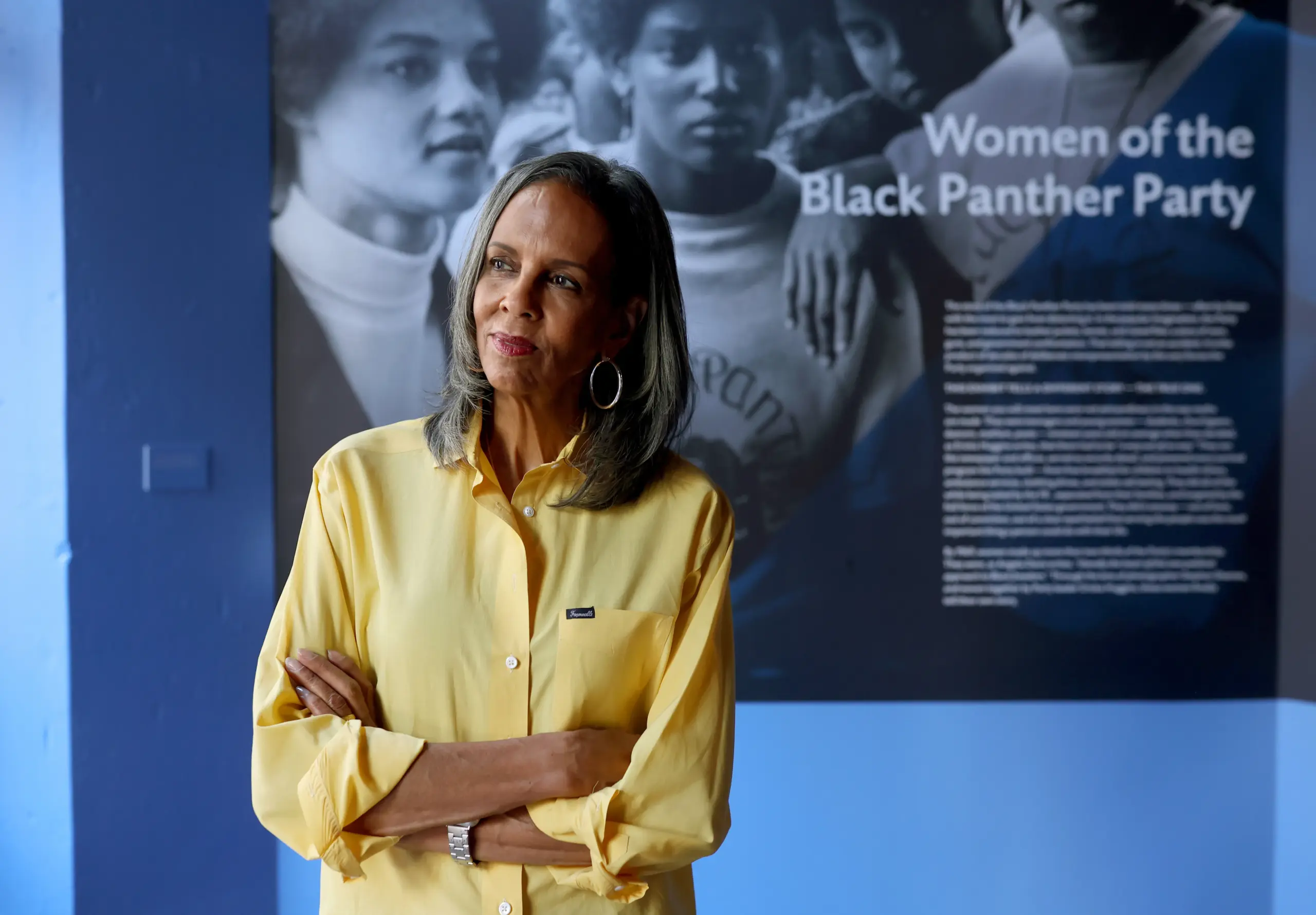
As explained in “Comrade Sisters: Women of the Black Panther Party,” a 2022 book and a current exhibit of photographs at downtown Oakland’s Black Panther Party Museum, women from all walks of life dedicated themselves to this Black revolutionary organization, which at one point had up to 5,000 members and more than 40 chapters across the United States.
Some rose to leadership positions, even in their late teens or early 20s. They say their labor and ingenuity kept the party’s programs running, some of which — like free breakfast for children and sickle cell anemia testing — have been replicated in local and national initiatives that continue to this day.
The Panthers’ best-known “survival program” was the free breakfast program, which served its first meal to elementary-school children in West Oakland at St. Augustine’s Episcopal Church in early 1969. It turned out to be so successful at feeding children and winning hearts and minds that it vexed FBI director J. Edgar Hoover, who was targeting Civil Rights activists. It also inspired Congress to establish the USDA’s school breakfast program in 1975.
Fredrika Newton, widow of party co-founder Huey Newton, recalls her long days of getting up at 5 a.m. to report to the free breakfast program. After she helped prepare and serve meals, she taught the members’ children at the Intercommunal Youth Institute, a precursor to the Panthers-run Oakland Community School. Both schools were set up to provide an alternative to public schools, which the movement considered racist and harmful to Black children.
“In the afternoon, you’re out selling (the party’s) newspapers, collecting donations, then at night you come home and make dinner,” she continued. She and other teachers looked after the children living at the institute and rotated overnight duties, which included keeping watch in case the police turned up. Like the party’s male leaders, including Huey Newton, Bobby Seale and Eldridge Cleaver, some of the school’s female staff became targets for surveillance by the FBI’s counter-intelligence operations, known as COINTELPRO, to disrupt counterculture organizations.
“It was, you know, hard work. There was nothing romantic about it,” said Fredrika Newton, who left Willamette University in Oregon at age 18 to join the party. She’s now the co-founder and president of the Dr. Huey P. Newton Foundation in Oakland, which promotes the history, ideals and legacy of the Black Panthers and is hosting the 60th anniversary conference.
Oakland poet Tureeda Mikell was a student nurse when she joined in the early 1970s. A self-described worker bee for the party, she put in countless hours at its free clinic. She took vital signs, helped with prenatal checkups, did sickle cell anemia and diabetes tests and cared for people in the throes of addiction.
Like Fredrika Newton, Mikell said she found the work profoundly meaningful — and necessary — because the U.S. government was not doing enough for Black people’s health and well-being.
“You know, we were dedicated to getting something done, to making something happen that we needed to have happen for the community, because there was (no one else doing it),” she said. In the decades since, historians have said the party’s clinic and work in healthcare helped focus attention on medical discrimination against people of color and the need for research on sickle cell anemia.
As other women described in their own memoirs, media interviews or oral histories, some of which are included in “Comrade Sisters,” the party appealed to them because they, like the men, grew up facing poverty, racism and a sense of political powerlessness.
Read more Election 2026: San Jose Unified school board candidates aim to repair community’s broken trust
Ericka Huggins, who ran the Oakland Community School from 1973 to 1981, said other female and Black activists put her on the path to the Black Panther Party. As a 15-year-old growing up in southeast Washington, D.C., she attended the 1963 March on Washington. She was amazed to see so many gathered and captivated by the speeches — though she noted they were all given by men. When activist and Hollywood star Lena Horne got a brief moment at the mic, Huggins recalls her silencing the crowd by singing out the word “Freedom.” Huggins said it was then that she made a vow to “serve the people the rest of my life.”
“I was drawn to the party because I read about it in Ramparts magazine, and it said, ‘The Black Panther Party is for all poor and oppressed people,’” Huggins said. A former professor of African American and gender studies, she is co-author of “Comrade Sisters,” with photographer Stephen Shames.
“The party always responded to the needs of the people,” said Huggins.
Serving their community as Black Panthers led these women to educational and work opportunities they wouldn’t have access to otherwise, given the discrimination against Black women in the ’60s and early ’70s. Huggins dropped out of a historically Black college at age 18 to join the Black Panthers in Los Angeles, and soon she and her husband, John Huggins, became party leaders there.
In 1969, John Huggins was killed by a member of another Black organization in a feud historians believe was fueled by the FBI. Several months later, Huggins, just 21, was separated from her baby daughter for two years when she was imprisoned on murder charges with party co-founder Bobby Seale in New Haven, Connecticut. This case sparked national debate over whether Black revolutionaries could get a fair trial.
A hung jury led to the charges being dismissed, and Huggins moved to Oakland, where she became director of the school, one of the party’s flagship programs. “We were in the heart of the Black and Brown community in East Oakland,” she said. It emphasized teaching children the power of self-love and thinking independently and became a national model for child-centered, community-based education, she said.
At the time, Huggins noted, she had no formal qualifications to run a school. “We just learned by doing,” she said. “It was kind of boots-on-the-ground learning. And I knew what children needed in order to be educated, and that’s where we started.”
The party represented a particular Black American response to economic inequities, racial indignities and police brutality in Oakland and other U.S. cities, said historian and City University of New York associate professor Robyn Spencer, who wrote the 2016 book, “The Revolution Has Come: Black Power, Gender, and the Black Panther Party in Oakland.”
The party’s openness to their active participation appealed to women and teenage girls who were developing a political consciousness around racial and gender inequality. Some, such as Joan Tarika Wilson, of Oakland, the first female party member, who joined in spring 1967 at age 16, saw the Panthers’ commitment to armed self-defense “as a marker of strength,” Spencer wrote.
Many were also drawn to the intellectual rigor within the party, whose program for members included weekly political education classes and robust reading lists on history, philosophy and literature, Fredrika Newton said. Women appreciated that the party was open to adapting its stance on gender politics, making it a viable alternative to the strictly hierarchical gender roles advocated by other Black organizations, such as the Nation of Islam, Spencer said.
Indeed, the party made room for Elaine Brown, the party’s Minister of Information, to become its leader in 1974. Brown’s 1992 memoir, “A Taste of Power,” opens with her onstage in an Oakland auditorium, filled “with predominantly male faces,” announcing that Newton had made her the boss while he went into exile in Cuba. “Here I was, a woman, proclaiming supreme power over the most militant organization in America,” she wrote.
While Brown wrote about “the chauvinism of Black Panther men” in her book, she said in an interview this week that, realistically, the party was originally started by men, notably a “visionary intellectual” like Newton. The party also made “women’s liberation a part of our struggle,” she said, adding: “We were all revolutionaries,” and both men and women had to put in the work and were judged on that, regardless of gender.
By the end of the 1970s, the party began to fall apart due to internal conflicts, the unrelenting scrutiny of the federal government and the ’80s cultural swing to conservatism, Spencer said. She also surmised that female party members wanted to move on from the unpaid community organizer lifestyle as they approached their 30s, some with children to raise.
Some women in the movement went back to school, finished degrees and pursued careers in nursing, teaching, politics, the law and the arts, with some becoming leaders in their fields. Newton founded the Huey P. Newton Foundation, and Huggins became a professor, an AIDS activist, the first Black person appointed to the Alameda County Board of Education and a meditation teacher. Meanwhile, Brown ran for Oakland City Council, became a prison reform advocate and became the CEO of a nonprofit that works to bring cooperatively owned businesses and affordable housing to West Oakland.
They also remain proud of the programs they ran, including those — like the free breakfast program, the school and the clinic — that have had lasting legacies.
Now these women are eager to use their experiences to preserve and promote the legacy of the Black Panther Party in American history and to share what it meant to the women involved. Fredrika Newton said the women “were given the opportunity or assignments that really followed them for the rest of their lives.” Brown added, “I remain committed to the principles of the party and what we started out doing. I remain a revolutionary.”
About the Author