Higher interest rates tend to make many people antsy. Who wants to pay more on their loans?
Read more NorCal Renaissance Faire returns for 6 weekends
Well, the Federal Reserve just hiked its interest rates for the first time in three years. And with mortgage rates above 7%, is it time to be nervous?
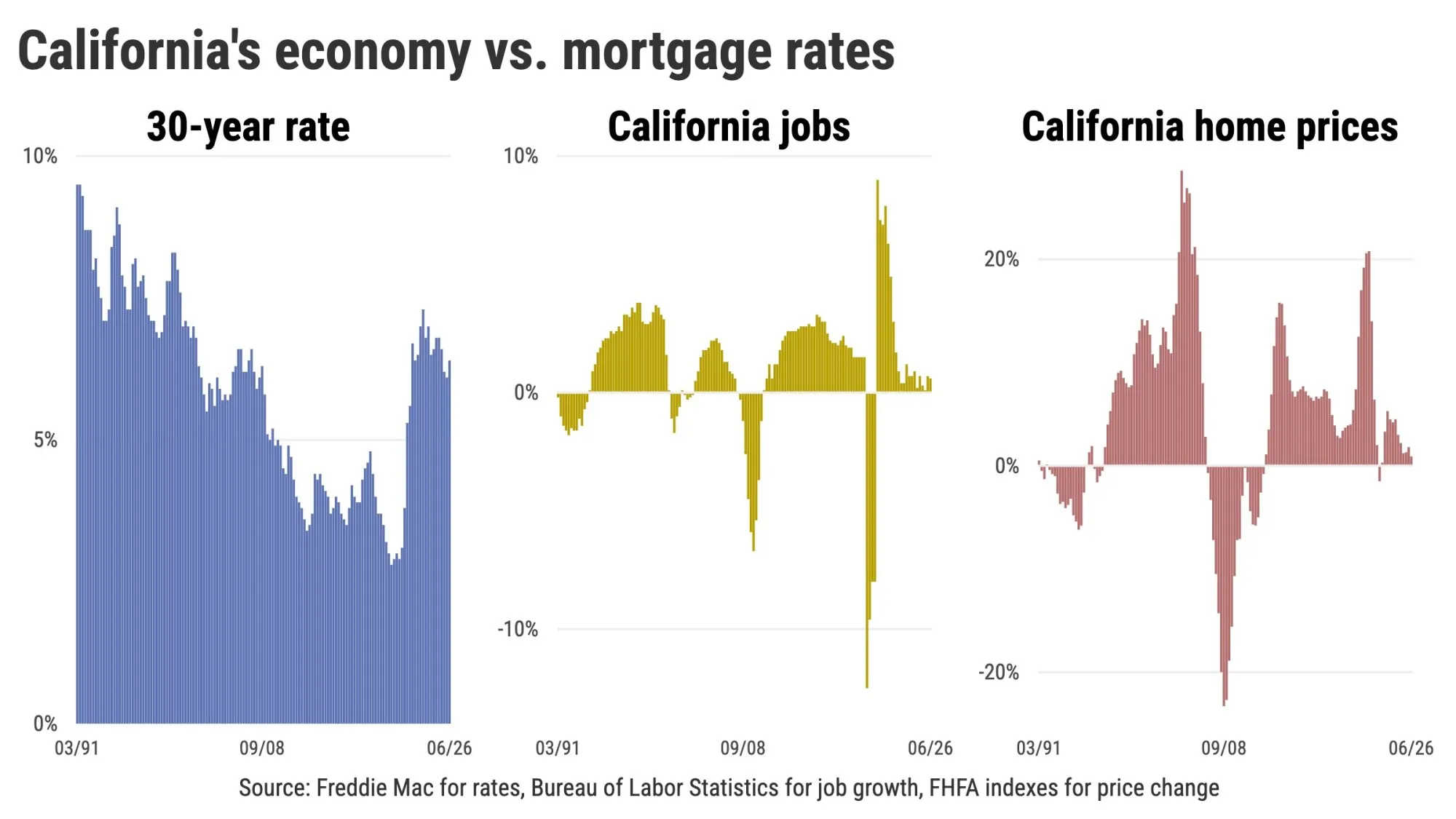
My trusty spreadsheet looked at quarterly data reaching back to 1990 to see whether the economy today has entered dangerous territory. Tracked were 30-year mortgage rates from Freddie Mac, job counts from the Bureau of Labor Statistics, and home prices measured by the Federal Housing Finance Agency.
The goal was to see how bosses and house hunters in California and nationwide react when mortgage rates are above 7%.
Mortgages at 7% have been rare since 1990. They didn’t occur until 1998, and have averaged 5.9% over the past 36 years.
Or look at the oddity this way: Just one-third of all quarters since 1990 had a 7%-plus average home financing rate.
So, do 7% mortgages crash the economy? Simply put, the numbers show that one year later, the job market tends to firm up as home price appreciation softens.
But please note, the odds of economic slips also increase.
What happens to hiring?
Remember, rates are typically high when the economy is heated.
How much expensive financing cools in the business climate over the following 12 months is the grand question.
Since 1990, California has enjoyed 2.1% median job growth in the year after rates were at 7% or more. But note that 33% of the time, job totals dropped in these 12-month periods,
Contrast that to employment patterns following rates below 7%: California had cooler, 1.5% median job increases in the year. Yet, 12-month periods with job drops occurred only 20% of the time.
So, above 7%, California typically sees more hiring and more volatility. Nationally, it’s somewhat muted.
The American worker saw 2.2% median job gains in 12-month periods after 7%-plus rates. Employment declines were seen 20% of the time.
When rates were below 7%, job growth cooled to a 1.5% pace as job totals fell 21% of the time.
Read more Hayward child pornography defendant says he’s ‘deeply’ sorry before getting 5+ years in prison
Bottom line: As far as your paycheck is concerned, 7% mortgages are a modest worry.
What about home prices?
It’s a bit of a puzzle, as cheaper mortgages — every house hunter’s dream – come with less job growth.
Higher financing costs, however, seem to limit how much a steady paycheck will buy.
When rates were above 7%, California home prices saw a mere 1.9% median gain in the next 12 months. And prices dropped in 43% of those periods.
Pricing was decidedly firmer when rates were lower.
Below 7%, history shows California homes appreciated at a median annual rate of 6.5% over the next 12 months.
But do not forget that low rates often signal economic distress, so price drops did happen 24% of the time.
Similar patterns were found nationwide.
With rates above 7%, U.S. home prices rose at a thin 3.8% median pace – but saw not a single decline. But below 7%? Higher 5% median gains but more drops, 20% of the time.
Rates can cool
It takes higher interest rates to cool the California economy than the national business climate.
Ponder what this 36-year economic history shows.
When jobs were falling in California over a one-year period, the median mortgage rates one year earlier was 7.1%. Nationally, job cuts followed a 6.7% rate.
And when California home prices were falling, mortgage rates were at 6.9% the year before. Compare that to 5.5% rates the year prior to national price dips.
Jonathan Lansner is the business columnist for the Southern California News Group. He can be reached at [email protected]
About the Author