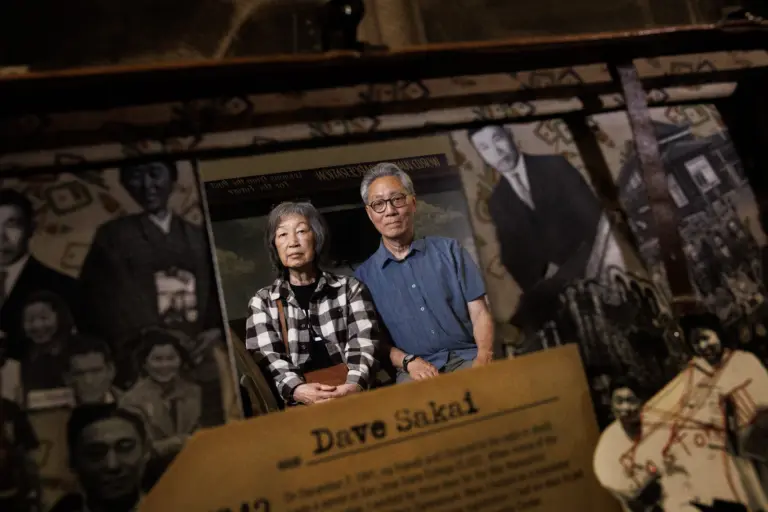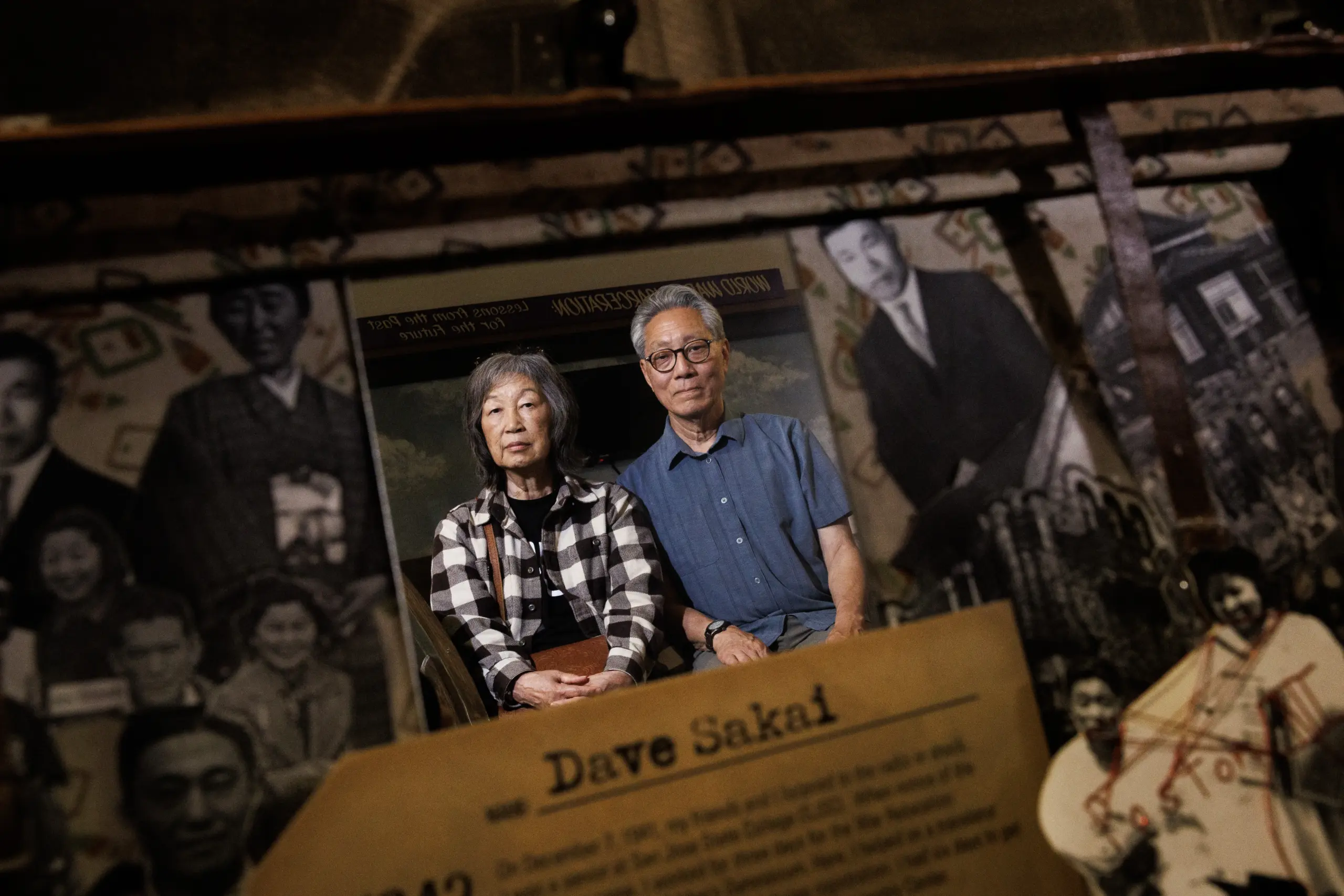
When Donald Tamaki’s father first held his Bachelor’s degree from Berkeley, he was living in a horse stable.
Read more DA seizes 12 guns, 3,700+ rounds of ammo in raid of Pleasant Hill home
After four years of study, the young Japanese American had successfully earned his degree, but before his graduation ceremony, the federal government began a crackdown on Japanese Americans. He and his family were forced to leave their homes and report to the Tanforan Racetrack in San Bruno. The whole family was detained there for months, living under a naked lightbulb, given pillowcases to stuff with straw, and hemmed in by barbed wire fencing and armed guards.
RELATED: ICE must pause construction of Gilroy facility, judge rules
Tamaki still has his father’s degree — held in a mailing tube addressed to the barrack and stall where his family lived — a reminder of the nationwide violation of civil rights that families like his endured during World War II.
For decades, he and other Bay Area Japanese American activists have connected their community’s history of internment and incarceration to the plight of other groups whose rights have been infringed, helping fight for legal victories for themselves and other immigrant groups. Now, many see striking parallels between the immigrants targeted by the federal government and the tragic legacy of internment and are joining fights from the local push against the ICE facility near Gilroy to national protest movements against what they label as the administration’s overreach.
“For Japanese Americans, we’ve seen this before,” said Tamaki, pointing to instances of families detained in warehouses and communities singled out in the name of national security. “We actually know something of what it is to be singled out and denied your rights. … It’s very personal.”
Incarceration and the fight for reparations
Following the attack on Pearl Harbor in December 1941, President Franklin D. Roosevelt signed Executive Order 9066, which authorized the forced removal of anyone deemed a threat to national security. In the ensuing months, that order was used to justify the wholesale removal of Japanese Americans from their homes regardless of citizenship or evidence that they posed a threat. Military agents began ordering Japanese Americans to report to “assembly centers” like the racetrack, with some being forced from their homes at gunpoint.
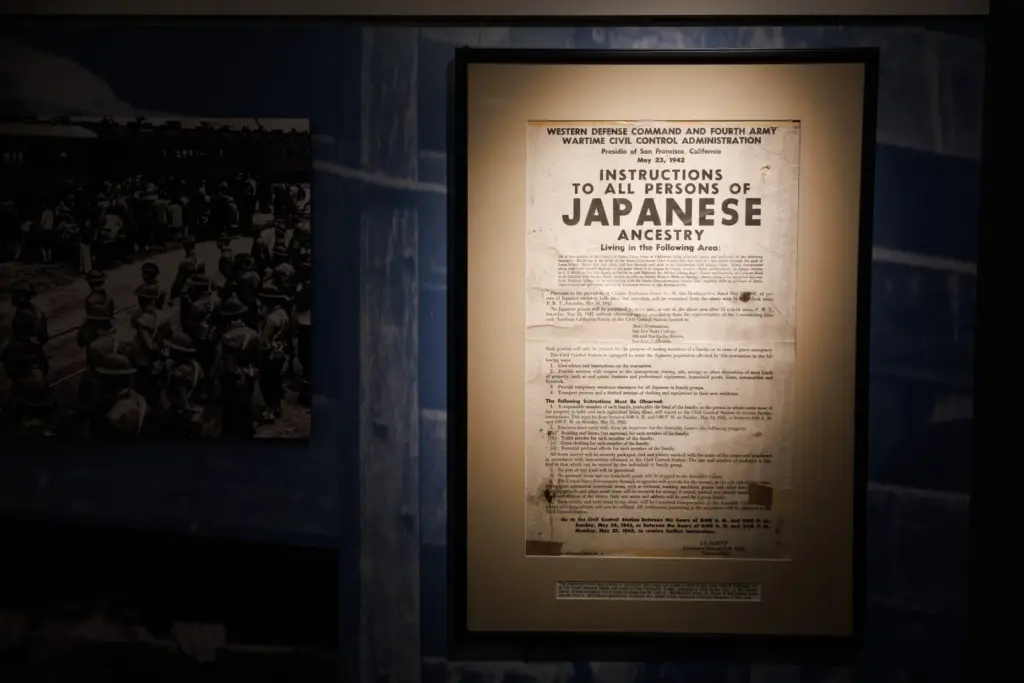 A 1942 poster displaying Civilian Exclusion Order No. 96, which ordered people of Japanese descent to report for forced removal and incarceration during World War II, hangs inside the Japanese American Museum of San Jose, Calif., on Aug. 12, 2026. (Dai Sugano/Bay Area News Group)
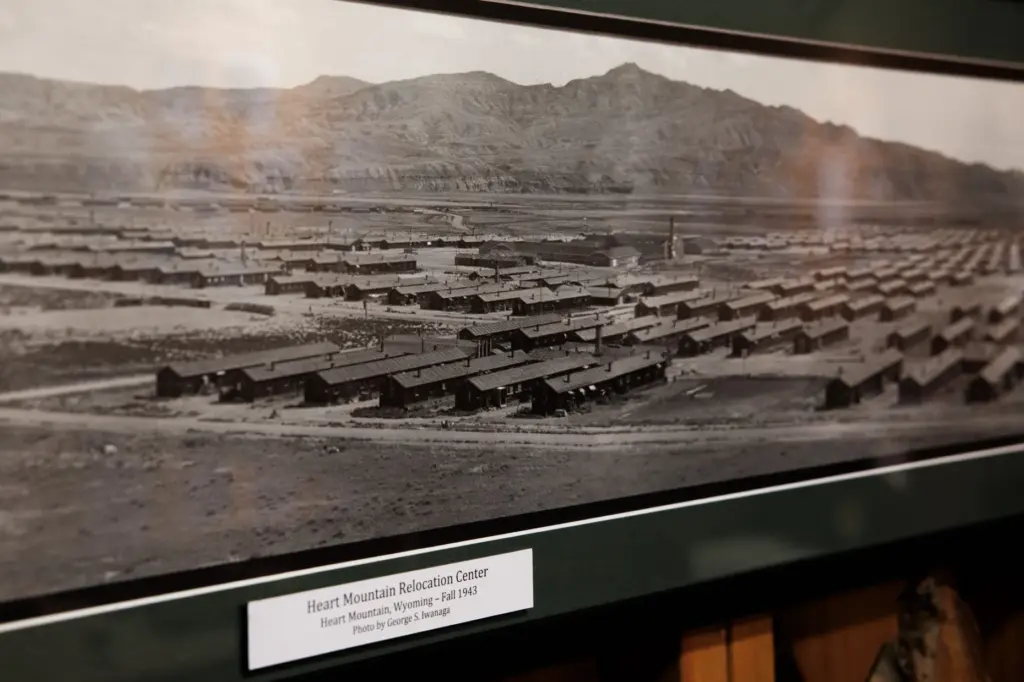 A picture taken by George S. Iwanaga in 1943 of the Heart Mountain Relocation Center in Heart Mountain, Wyoming, is displayed at the Japanese American Museum of San Jose on Aug. 12, 2026. (Dai Sugano/Bay Area News Group)
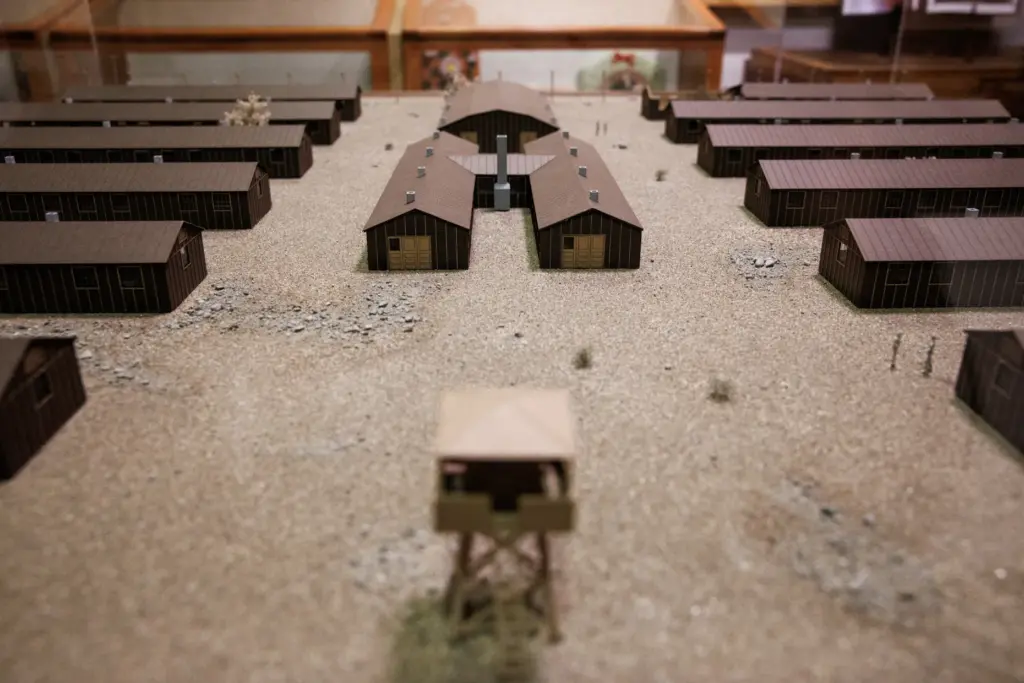 A miniature model of an internment camp during World War II is displayed at the Japanese American Museum of San Jose on Aug. 12, 2026. (Dai Sugano/Bay Area News Group)
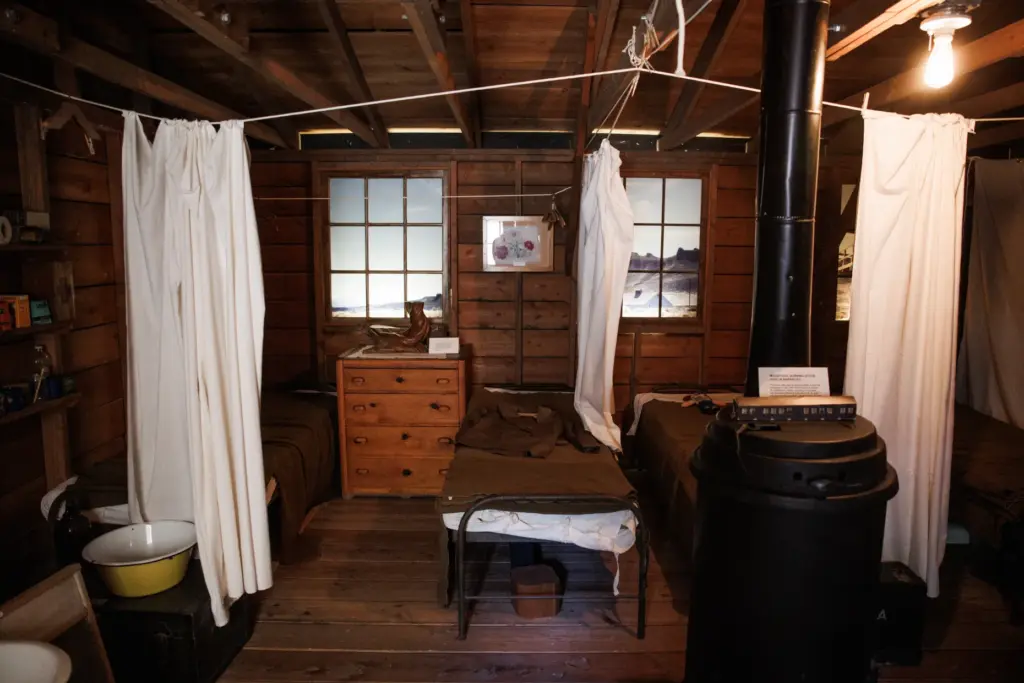 A replica room constructed to simulate the interior of a typical barracks room in Japanese American internment camps during World War II is displayed in the Japanese American Museum of San Jose on Aug. 12, 2026. (Dai Sugano/Bay Area News Group)
Over 120,000 Japanese Americans were relocated and imprisoned in internment camps. Many suffered abuses, and in some cases were denied adequate food and medical care — at times leading to harrowing cases of death, including of children.
Many of those who lived through the camps tried to forget their struggles and move on, facing pressure to assimilate and avoid becoming a target of the government. Meanwhile, media representations of Japanese Americans at the time often underplayed the abuses of the camps and the displacement that preceded them.
“We grew up under that pressure of erasure,” said Susan Hayase, co-founder of the Japanese American activist group San Jose Nikkei Resisters. The pressure and the racism she experienced “makes you self-conscious, makes you feel like you don’t fit in, makes you feel alienated.”
Decades later, Hayase became part of the formation of The National Coalition for Redress/Reparations, a movement that fought for reparations and acknowledgement of the wrongdoing against Japanese Americans. She and others encouraged Japanese Americans to testify to the federal government about the abuses they endured under internment.
At the same time, a case moving through federal court would fly in the face of the government’s justification of internment. A welder at a shipyard in San Francisco, Fred Korematsu was ordered to report to Tanforan racetrack. He refused. Instead, he attempted to evade detention by changing his name and undergoing plastic surgery — and was later arrested and convicted for his refusal. Korematsu appealed, eventually taking his case to the Supreme Court in 1944. The court sided with the U.S. government in a 6-3 decision that claimed that the internment was acceptable given the national “emergency.”
But in 1980, a researcher from UC San Diego found documents from the federal government showing that lawyers and members of the military in the 1944 case had withheld, fabricated or destroyed evidence, suppressing the FBI’s own intelligence that found no evidence of espionage or sabotage by Japanese Americans. Korematsu’s internment — and that of tens of thousands of Japanese Americans — was based on lies.
Using that evidence, a group of lawyers, including Donald Tamaki, fought to have Korematsu’s conviction cleared, winning the case in 1983.
Building on the testimonies of camp survivors, Korematsu’s case and the revelation of the government’s own lies, Japanese American members of Congress, including local Rep. Norman Mineta, sponsored a bill that granted $20,000 — about $56,000 in 2026 — to eligible surviving Japanese Americans who were interned. In 1988, President Ronald Reagan signed the bill into law.
The fight for the rights of others
While the bill — known as the Civil Liberties Act of 1988 — signaled a clear victory for Japanese Americans, woven throughout the fight for reparations was the idea of protecting others who might face similar threats to civil rights. One of the guiding principles of The National Coalition for Redress/Reparations was to support the struggles of other oppressed peoples, and in testimony in front of the judge who vacated his conviction, Korematsu made a clear connection between his fight and those of others: “I would like to see the government admit that they were wrong … so this will never happen again to any American citizen of any race, creed or color.”
That connection helped spur a long legacy of activism and advocacy.
Betty Duong, Santa Clara County Supervisor and the daughter of Vietnamese refugees, credits the Japanese American community with welcoming families like hers in the ‘70s, by lobbying government leaders to accept refugees from Vietnam and Southeast Asia into the county. That welcome, she says, helped change the face of the South Bay and bring in one of the communities that define San Jose.
Read more Horoscopes September 14, 2026: Andrew Lincoln, be the one to make a difference
“That history of solidarity changed the trajectory of our families’ lives, of all communities’ lives,” said Duong. “I stand here today because of this legacy, because of the Japanese American community. When other communities say ‘don’t come here,’ this community says ‘you belong here.‘”
While many Japanese American activists spoke out against the backlash against Arab Americans following the Gulf War and Muslim Americans after 9/11, much of the current concern has centered on the policies and public declarations of President Donald Trump and his first and second administrations. Japanese American activists point to the so-called “Muslim Ban” — which restricted visas and travel from majority Muslim countries in the name of combating terrorism, the scapegoating of China during the height of COVID-19 and the ensuing wave of violence against Asian Americans, and the portrayal of Chinese academics as potential spies.
“We saw that repeating of history,” said Dale Minami, who worked on the Korematsu case. “We have the moral authority from having been imprisoned without due process to stand up for other groups, not just Japanese Americans, Asian Americans, but those who are being singled out, profiled.”
But across more than a half-dozen interviews, advocates pointed to the current immigration enforcement crackdown as the most striking parallel with the internment of their parents and grandparents.
The detention of people without due process as well as the deaths, abuses and dire conditions at detention centers ring alarm bells for many Japanese American advocates. During World War II, around 50,000 of those detained were first-generation immigrants without citizenship — legally barred from having a pathway to citizenship by discriminatory federal law. Currently, Immigration and Customs Enforcement holds over 60,000 people in detention, and over 70% have no criminal conviction.
In March 2025, President Trump invoked the Alien Enemies Act against members of the Venezuelan gang Tren de Aragua — the same law that was used to justify the detention and arrest of Japanese Americans, as well as Germans and Italians.
“The fabrications that are going on … the similarities between then and now are striking,” said Donald Tamaki, who worked on Fred Korematsu’s case. He argues that falsehoods around immigrant groups — as well as what he calls the unfounded labeling of Alex Pretti and Renee Good as domestic terrorists — mirror the lies used to justify the Japanese internment.
Former Secretary of Homeland Security Kristi Noem defended the characterization in a Senate hearing, saying that it was based on reports from immigration officers “at the scene.” But the heads of two federal immigration agencies said that they did not provide Noem with an assessment that stated that Pretti and Good were terrorists, according to reporting from The New York Times.
The anti-immigrant actions have helped spark several groups of Japanese Americans across the Bay Area to push back against the immigration policy. In 2017, Hayase co-founded San Jose Nikkei Resisters, and the group has been outspoken at protests and rallied against issues like the proposed ICE facility in Gilroy.
Meanwhile, other Asian and Japanese American groups have held “know-your-rights” forums for immigrants, with groups like the Asian Law Alliance in San Jose joining the Rapid Response Network, while the Japantown Sanctuary Network in San Francisco has helped support immigrants showing up to immigration check-ins. Many San Jose Japantown organizations have banded together to form the Neighbors Not Enemies coalition, which advocates for the repeal of the Alien Enemies Act and to “stand up for our neighbors who are currently being targeted by racist immigration policies.”
While some groups focus on challenging and changing policy, other advocates have focused on changing minds through education.
“Because we have not learned the lessons of history, we are continuing to make the same mistakes,” said Karen Korematsu, daughter of Fred Korematsu. She heads the Korematsu Institute and, along with Minami and Tamaki, co-founded the Stop Repeating History campaign, which serves to educate others across the country about the nation’s fraught history of discrimination and advocate for civic engagement. Karen Korematsu has become a champion for ethnic studies and helped formulate the model curriculum for California’s ethnic studies program.
Amid repeated violations of civil rights and cuts to education and ethnic studies around the country, it is essential to educate the next generation and inform the current generation, she said — by understanding our history, we can break the cycle of repeating it.
“We need to get out of our silos, and we need to connect our different histories together,” she said. “The names and the faces may change, but our struggle for justice is the same.”
Read more Asking Eric: My sister posts tradwife videos but it’s all fake
About the Author