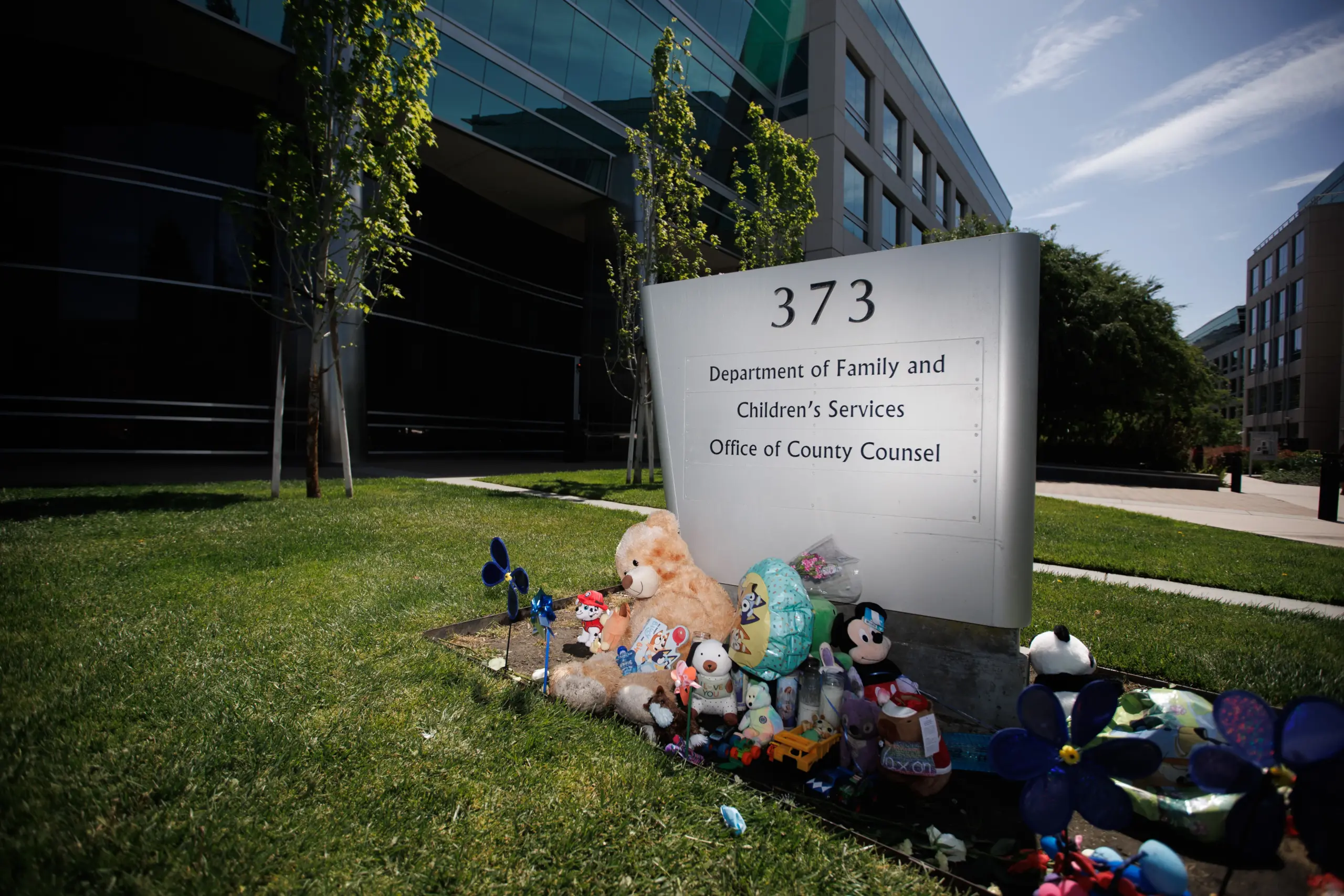
Since baby Phoenix Castro’s fentanyl overdose death at home in 2023 forced a fundamental reckoning at Santa Clara County’s child welfare agency, the number of children removed from their troubled homes has nearly tripled.
Read more Kurtenbach: 49ers can’t beat Rams, Seahawks without mastering the art of hidden yardage
Parent advocates say this is a sign of a “foster care panic,” an overcorrection fueled by intense media scrutiny and damning state investigations over the death of Phoenix that they contend has spurred removals at an alarming and unnecessary rate. The newborn had been sent home with her father who had a history of drug abuse over dire warnings that she could die there.
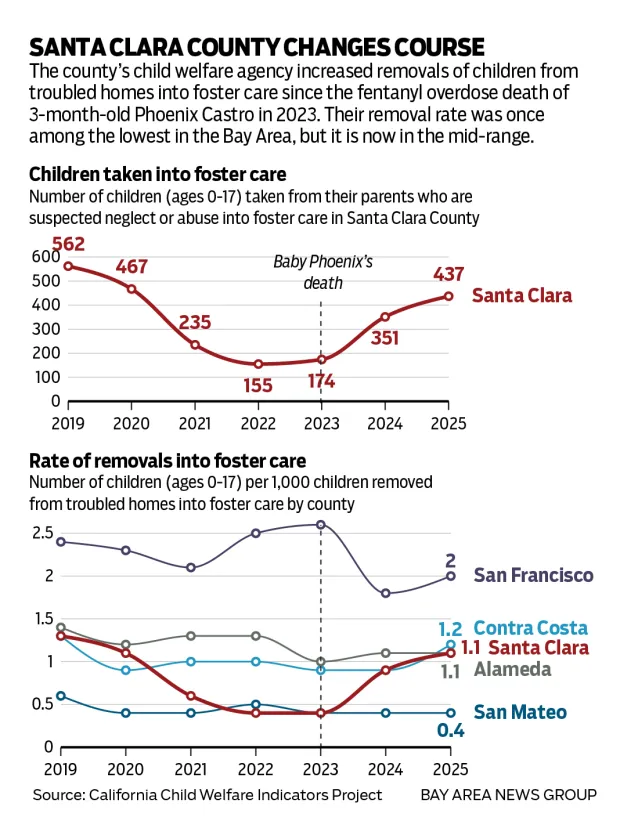
But data from the state Department of Social Services show that while the number of removals to foster care in Santa Clara County surged to 437 in 2025 from 155 in 2022, they remain close to numbers seen before the dramatic policy change and now closely match removal rates of neighboring Bay Area counties. About 1 child per 1,000 is placed in foster care in Santa Clara County. Alameda County, the subject of state and civil grand jury investigations over the 2022 death of 8-year-old Sophia Mason, has a similar entry rate into foster care.
San Francisco, however, along with California as a whole, places about two out of every 1,000 children in foster care. Those numbers alone, however, can’t determine whether social workers’ fears of another tragedy, or losing their jobs as a result, is driving unnecessary removals in individual cases.
In a statement from the county’s Department of Family and Children’s Services, Director Wendy Kinnear-Rausch said that foster care panics are a nationwide phenomenon that often occur when a child’s tragic death becomes highly public, “and Santa Clara County is not immune.”
“What I see happening in Santa Clara County right now is a very fear-driven response,” said Jerry Milner, the former head of the U.S. Children’s Bureau who co-founded The Family Justice Group, a nonprofit advocating family preservation. “No worker wants to be the next front page of the headlines of the newspaper.”
But Steve Baron, a member of the county’s Child Abuse Prevention Council who emphasized he was speaking on his own behalf, said instead that “what has occurred is a correction reprioritizing child safety rather than an overreaction.”
At least six children involved with the county’s child welfare agency have died over the past four years, including 2-year-old Jaxon Juarez who died in April after being placed in the foster home of his cousins, where authorities say he was repeatedly sexually assaulted. The Child Death Review Team, led by the county coroner, found that in 2022, parental neglect contributed to the deaths of three local children, who had been the subject of repeated referrals urging the county’s child welfare agency to intervene.
Jaxon died just as the state Department of Social Services was wrapping up an 18-month oversight of the county agency after Phoenix’s death. Social workers had placed Jaxon in the home of his cousin who had a record of felony child endangerment that should have been disqualifying, according to county policy. The cousin’s teenage son has been charged with murder. Four social workers involved in the case are undergoing termination proceedings, while three others have either resigned or retired.
The recent surge in removals came after a dramatic drop, brought on by both the pandemic, when child welfare cases decreased overall, and an edict imposed by Daniel Little, then-leader of the county’s Department of Family and Children’s Services. In an effort to fix the disproportionate representation of minority children in foster care, he explained in a January 2021 email to social workers, his new policies would “prevent the need for removal of children from their homes.”
“Children do best with family,” he would later say, and social workers would need authorization from county lawyers before removing children. In October 2023, Little was honored as a “trailblazer” for keeping children out of foster care by the Dependency Advocacy Center, whose lawyers represent parents navigating the child welfare system. By then, Little was promoted to director of the county’s Social Services Agency, where he continues to serve.
Within days of that honor, however, the county coroner concluded that baby Phoenix had died of a fentanyl overdose, prompting social workers to flood Board of Supervisors meetings and accuse their bosses of focusing more on family preservation than child safety. The infant, born with drugs in her system, was sent home despite a plaintive, written warning from a social worker who explained that the parents had already lost custody of their older children because of drug use and neglect and had not followed through with programs to get them back.
Are those social workers now removing too many children out of fear of another tragedy?
Kinnear-Rausch said that her agency is “committed to making the right individualized decision for each child — intervening when a child is found to be unsafe and also providing support (for) families to prevent abuse or neglect.”
At the same time, she said, “we’ve heard clearly from the community about disproportionate impacts on Black and Latino families and deep concern about families being separated unnecessarily, especially as more children are placed outside the county and social worker caseloads continue to grow.”
Zeb Feldman, the staff leader at the county’s CEMA union of social worker supervisors and managers, said that the increase in removals caused some chaos within the department, as overworked social workers were reassigned to the newly court-heavy caseload. He also acknowledged that since Phoenix’s death, “we’ve lowered the bar” on the circumstances prompting removals. Social workers, not county lawyers, now have more authority in determining whether children should be removed from their homes.
“Whether the end result is appropriate or not,” Feldman said, “I’m open to the possibility that you have a knee-jerk reaction to public pressure and the board and executives yelling at us every meeting, and then the knee-jerk reaction happens to be the right one.”
Joanna Jimenez says the removal of her 2-year-old autistic son, Nathan, was a wrong one and may have been driven by a foster care panic. According to county records reviewed by this news organization, social workers determined that his mother failed to protect him from witnessing a domestic violence incident when his visiting father allegedly struck his mother — an experience the county said placed Nathan at substantial risk of physical harm.
Despite the mother’s contention that she was protecting him from that violence and had agreed to a safety plan, her child was placed in foster care one day after Jaxon’s death. He was moved among four foster homes over four months as Jimenez complained about bite marks and other injuries she noticed during her weekly visits.
Read more Bay Area events calendar for Sept. 11-17 weekly editions
“Is it because of baby Jaxon? Is it incompetence?” Jimenez asked during an interview with this news organization. Last month, a judge allowed Jimenez to regain custody as long as she participated in therapy and parenting classes, conditions that Jimenez said she readily accepted.
The county declined to comment on her case. But Jimenez’s lawyer, Maggie Cockayne, called the county’s increase in removals “extremely reactive.”
The Dependency Advocacy Center where she works announced this summer it would be forced to close because it couldn’t handle the explosion of removal cases that took them to court. County supervisors approved an extra $400,000 to keep it open.
“Ripping children away from their parents is very traumatic,” Cockayne said, “and they can’t be doing it willy-nilly as a knee-jerk reaction to Baby Phoenix.”
Keeping children in their troubled homes without proper oversight is also problematic, the state investigation following Phoenix’s death found. From July 2022 through March 2024 — a time when agency leaders were promising support services for parents — safety plans were not developed or monitored in 55% of cases where there were safety concerns in the home, and no formal protocols were in place for social workers to follow when families didn’t follow through on their parenting programs.
During the supervisors’ meeting last month with the panel of experts, Supervisor Sylvia Arenas expressed frustration with the recent tragedies, including Jaxon’s death that came after 18 months of state oversight and reforms.
“We can’t keep up this rate of death in our county,” Arenas said. “I’m not saying foster care is a solution. What I was hoping to hear from you is that there were other strategies that were being used … somewhere where we might be able to mitigate for those deaths. To actually look at our system and say these are the points where we are failing our children because that’s a failure. A death is a failure.”
She didn’t get easy answers.
“What’s the right rate at which children should enter foster care? Of course that’s an impossible question to answer,” said Wendy Wiegmann, project director at UC Berkeley’s California Child Welfare Indicators Project, an effort run by state welfare officials and university researchers to collect and analyze child welfare and foster care metrics. “We don’t know the true rate at which children are abused or neglected. We don’t know the true rate at which children need to have foster care.”
Research in all 50 states over the past 50 years, however, shows that states that increased their foster care entries saw no decline in child deaths, said panelist Kelly Fong, associate professor of sociology at UC Irvine who studies policies affecting youth in the child welfare system.
“The reactive impulse is to say … that our response has to be to compensate and shift our foster care entry numbers back up,” Fong told the supervisors. “We’re not seeing, in a national perspective, that that is related in any way to maltreatment fatalities.”
Milner, the panelist who co-founded the family preservation nonprofit, cautioned the supervisors from thinking foster care is the solution.
“I encourage you to find out what happened and to make corrections when they’re needed,” he said. “But what I do not encourage you to do is to jerk your entire system into one that systematically removes children out of fear.”
Arenas, who has been critical of the agency’s leadership since Phoenix’s death, asked: “What does the research say about the trauma from remaining in an abusive home?”
UC Berkeley social welfare professor Jill Berrick, another panelist whose research focuses on child welfare systems, responded that maltreated children, whether at home or in foster care, are more likely to experience problems with substance abuse and depression and are likely to die younger.
“Maltreatment has an effect that is potentially cellular,” she said, and children in foster care “struggle in many, many domains” including education, housing and employment. But so do children mistreated at home, she said.
“It’s very easy to come to the conclusion that foster care is bad for kids,” she said. But because foster care is a relatively short-term experience, about 10% of their childhood, she said, “we don’t know whether it’s a powerful intervention toward the positive or a powerful intervention toward the negative.”
Another state investigation that began after Jaxon’s death in foster care is expected to be released in the next couple of weeks. The findings may lead to yet more scrutiny about how decisions are made to place children in foster care. Whether it will shed light on how the county can avoid two critical mistakes — leaving a child in danger at home or unnecessarily separating a family — remains to be seen.
Santa Clara County Supervisor Betty Duong, who grew up with interventions from social workers for most of her childhood in East San Jose, cautioned against simple answers.
“Every child deserves a tailored approach, a plan for them,” she said. “We have not been able to figure out a way to wrap ourselves around an individual and treat them as an individual.”
Read more Inman Down Under: Handshake agreement gets 49ers into Week 1 mode
About the Author