POINT REYES —Salvage workers who had been struggling to pull a grounded fishing vessel out of the surf zone at Point Reyes National Seashore finally met with some success late Wednesday.
Read more Exclusive: 49ers sought Palo Alto police report before disclosing Shanahan crash, records show
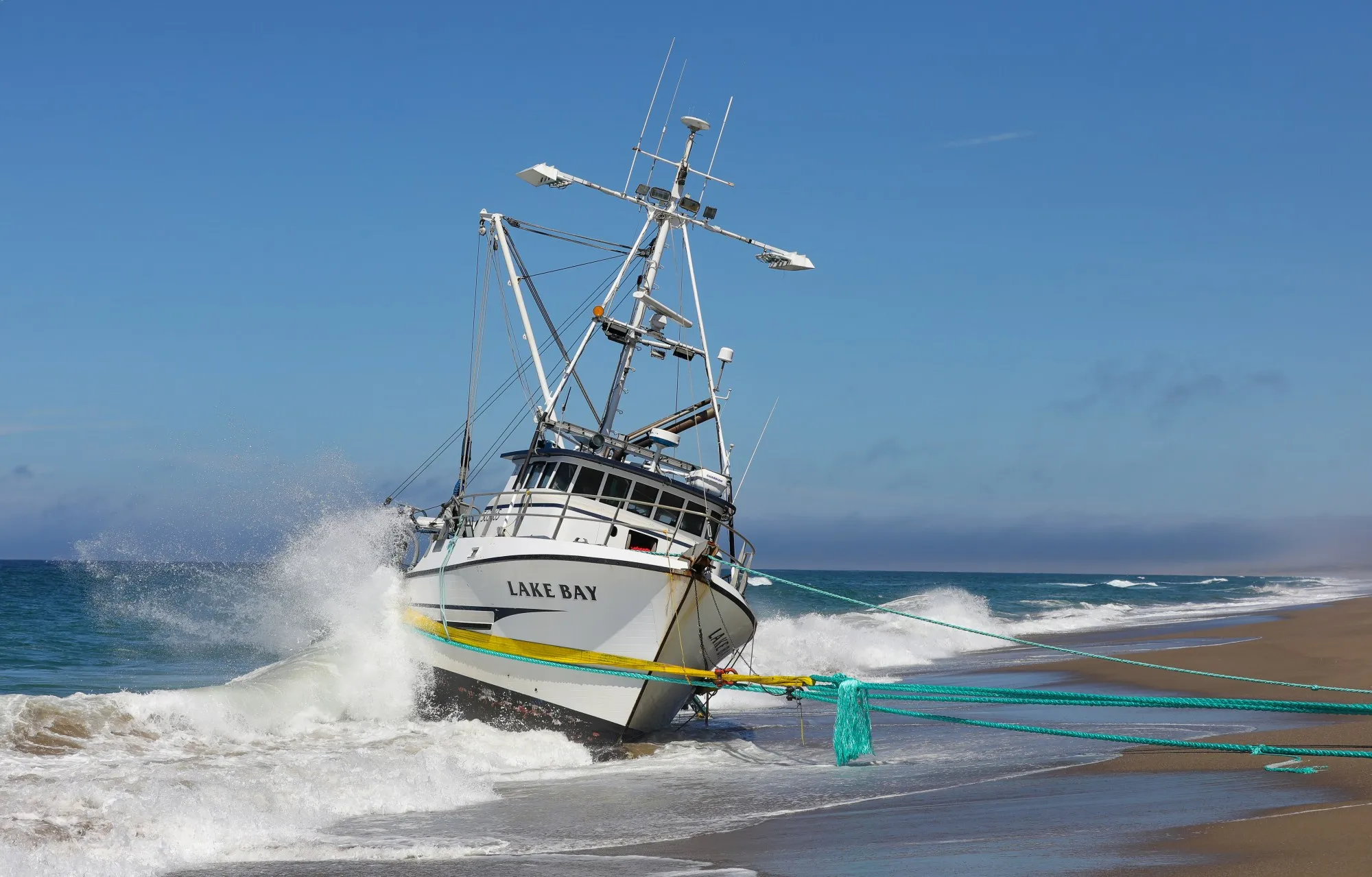
Five days after the 58-foot Lake Bay ran aground on a sand bar on remote North Beach in Marin County, crews took advantage of an incoming tide – and the pulling power of a second bulldozer – to drag the stranded craft further up onto the sand.
“It’s still kind of in the high tide area” said Lt. Cmdr. Carey Lewis, the incident commander in charge of the Coast Guard’s response to the emergency.
Once the boat is far enough onto the beach, “They’ll start the process of removing the squid,” said Lewis, pinpointing the primary reason the boat has been so hard to budge: It has 40 tons of squid in its hold.
“It’s extremely heavy with that squid in there,” said Gene LaPointe, who was stringing yellow caution tape in a wide area around the commercial trawler late Tuesday morning.
Crews have been stymied getting all that calamari, now “congealed together,” as Lewis put it, out of the tanks. After failing to make progress using a pair of four-inch pumps, said LaPointe, they rented a “bad-ass” six-inch pump.
“But that wasn’t doing it either. It just was not moving squid.”
Earlier in the day, LaPointe had taken part in an effort to dislodge the vessel with a bulldozer. Despite the salvagers’ use of a heavy-duty pulley anchored by a pair of giant excavators – a rigging system that doubled the bulldozer’s pulling power, he explained – the boat moved only a few feet.
The bulbous bow of the Lake Bay, a fiberglass craft built in 1975 and registered out of Smith River, California, was making the job of extracting the vessel even harder, said Lewis. “It’s basically digging into the sand.”
Asked if the Coast Guard had considered pulling the Lake Bay back out to sea, Lewis said that once a boat of this size runs aground, as this one did, “the stability of that vessel is in question.
“So even if you were able to pull it from where it’s aground, there’s no way to know there’s no breach to the hull,” he said.
“The vessel could start taking on water,” he added, raising the possibility that the diesel fuel it was carrying “could discharge in an environmentally sensitive area.”
The coastal waters directly off the Point Reyes National Seashore are part of the federally protected Greater Farallones National Marine Sanctuary. Workers succeeded in emptying the Lake Bay’s fuel tanks, extracting 1,400 gallons of diesel, along with 160 gallons of “hydraulic and lube oils,” Lewis said.
Rescuers ordered to stand down
After the Lake Bay foundered on that sandbar around 1 a.m. on Aug. 21, it sent out calls for assistance. Arriving before the Coast Guard was the Night Wind, a fishing boat out of Spud Point Marina in Bodega Bay. Its crew attached a tow line to the Lake Bay, according to several sources, and was trying to pull it into deeper waters when the Coast Guard arrived, and ordered a halt to that rescue operation.
The Coast Guard’s decision to sacrifice the Lake Bay, rather than join the effort to rescue it, has stoked some anger in the North Bay’s commercial fishing community, dredging up resentment around the Guard’s previous responses to grounded vessels.
In February 2024, a 57-ton fishing boat called the Aleutian Storm ran aground on a sandbar off Salmon Creek State Beach, on the Sonoma Coast.
Like the skipper of the Lake Bay, the Aleutian Storm’s captain radioed for help to the Coast Guard. As it did with the Lake Bay, the Guard responded with caution, erring on the side of safety and concern for the environment. Shallow water and breaking waves kept the Coast Guard rescue boat from coming within 700 feet of the Aleutian Storm, preventing an attempt to tow the stranded craft off the sandbar.
It became grounded, then, over many days, was dismantled by heavy equipment and hauled away, piece by piece. That’s now the likely fate of the Lake Bay.
In the wake of this latest wreck, some members of the tightly knit local commercial fishing community have begun discussions with county officials, said veteran fisherman Dick Ogg, president of the Bodega Bay Fisherman’s Marketing Association, to come up with some “potential options,” which, in the case of future groundings, “would give fishermen and the Coast Guard an opportunity to work together to find a solution to get that boat off the sandbar.”
Any such agreement, he said, would embrace the Guard’s top priorities of “life-safety,” as he put it, as well as regard for environmental impacts.
But it would also recognize what Ogg described as the fishermen’s ability “to potentially engineer a method to get that boat off the beach.”
He and his peers “have a good understanding of current flow, of wave action, of water depths — of what we can do to mitigate these potential issues” that can arise when a vessel is grounded, Ogg said.
What fishermen will likely ask for, he added, is a 36-hour window, after a vessel runs aground and isn’t in immediate danger of sinking, that would give members of the fishing community a chance to save it.
He and others are in process of preparing a pod, or container of equipment, to assist in case of such emergencies.
That equipment will include various pumps, absorbent “oil pads,” to capture leaking engine fluids or fuel, and a small robotic craft designed to deliver a tow line to a disabled vessel – eliminating the risk of collision with a rescue boat.
From a fleet of ‘tanks’
The Lake Bay is a purse seiner, meaning it used its giant vertical net – now wadded up in a tangled pile on the beach – to encircle schools of fish (and most recently, squid), then close at the bottom like a drawstring purse.
The craft was built in 1975 by Delta Marine.
“I’ve had a Delta,” said Ogg. “They are built phenomenally well, some of the best-made fiberglass boats on the ocean right now.” Even five days after it ran aground, Ogg believes, the Lake Bay “could and would be repairable.”
“They are absolute tanks.”
Seeing it pulled ashore, later to be destroyed, “is just hard for us to understand,” he said.
“So let’s sit back, look at this and say, ‘Okay, the next time this happens, what can we do, engineering-wise,’” to save the boat.
Lewis acknowledged that “this is an incredibly stressful and emotional situation for the owner, and also the local community.” He also pointed out the Coast Guard’s responsibility to weigh the risk of “having a vehicle that size, with that amount of fuel, sink in a national marine sanctuary.
“I don’t think the public would’ve been happy about that.”
You can reach Staff Writer Austin Murphy at [email protected] or on Twitter @ausmurph88.
Read more Norway’s crown prince becomes King Haakon VIII after his father’s death
About the Author