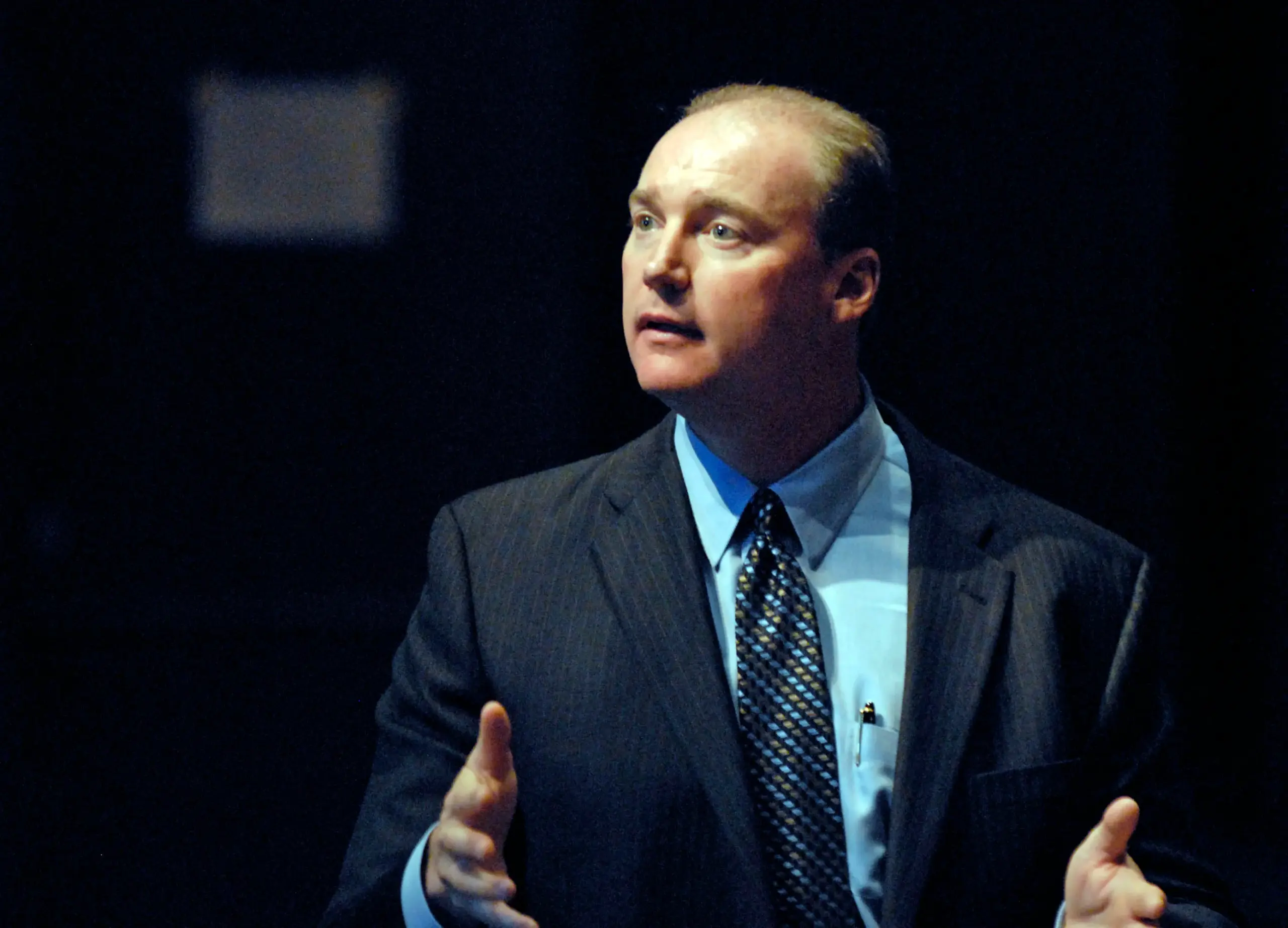
REDWOOD CITY — A former San Mateo County community college chancellor was sentenced Friday to eight months in county jail for perjury and filing false tax returns, with a judge rejecting his expressions of remorse and telling him that he appeared to think he was “governed by different rules.”
Ronald Galatolo was convicted in January of four felony counts each of tax evasion and perjury, involving false tax returns, undisclosed gifts and vehicle purchase prices he misreported to the DMV. Galatolo, who had remained free pending sentencing, was handcuffed and taken into custody after the hearing. He will also serve two years of probation and complete 100 hours of community service in a Latino community.
In a letter to the court, Galatolo wrote that he had “made some bad decisions” and “should have been more diligent in preparing my taxes.”
“Over the course of my years on the bench, I’ve read hundreds of letters of remorse … and what I have learned, among other things, is that it’s easy to say ‘I’m sorry,’” San Mateo County Superior Court Judge Leland Davis III told Galatolo. “But I have to say, sir, there’s no good feeling behind your words.”
Davis said the letter sought to “minimize or explain away” Galatolo’s conduct rather than acknowledge that he had acted dishonestly. Although the judge commended Galatolo for improvements made to the college district during his tenure, he said the former chancellor’s comments suggested that he considered himself exempt from rules governing others.
“I hope, sir, that through the term of your probation you’ll be able to fully acknowledge your wrongdoing and sincerely feel remorse for what you’ve done,” Davis told him.
The sentencing capped a sprawling prosecution in which prosecutors accused Galatolo of accepting gifts, including Super Bowl tickets and first-class travel to Dubai, in exchange for steering lucrative construction contracts to firms associated with his friends.
Galatolo’s defense argued that he did not decide which firms received contracts and that the gifts were either reciprocated or exempt from disclosure requirements. Jurors could not reach verdicts on 18 charges involving embezzlement, conflicts of interest and misuse of public funds. They acquitted Galatolo of another perjury charge involving gifts reported on his Form 700, which public officials must file to disclose economic interests.
San Mateo County District Attorney Stephen Wagstaffe decided in March not to retry the unresolved charges, saying Galatolo would still “remain a convicted felon for the rest of his life” and faced an appropriate sentencing range for the eight counts on which he was convicted.
At Friday’s hearing, Deputy District Attorney Joseph Cannon argued for a prison sentence, describing Galatolo’s conduct as a “pattern of fraud” spanning his personal and professional dealings.
Cannon said Galatolo had access to information entrusted to him as chancellor and “abused it to enrich himself.” He pointed to a $10,000 donation the district made to the Santa Rosa Junior College Relief Fund that Galatolo claimed as a charitable contribution on his personal tax return, conduct underlying one of his convictions.
“Mr. Galatolo was showered with gifts — concert tickets, travel, sporting events, you name it, and literally all he had to do is declare it,” Cannon said.
Galatolo’s defense attorney, Charles J. Smith III, argued that the criminal conduct should be weighed against the rest of his client’s life, including improvements made to the community college district under his leadership. Smith asked the court to impose probation or allow Galatolo to serve any jail sentence through a sheriff’s work program.
Read more SF Giants fall to Padres in final game before Monday’s trade deadline
Smith characterized Galatolo’s crimes as private misconduct rather than public corruption, arguing that jurors did not accept the prosecution’s theory that Galatolo enriched himself by accepting gifts in exchange for government contracts. He also said “nobody was hurt” and “nobody lost money” because of the unreported gifts.
“If lack of integrity was a crime, there’d be lots of people we can all name who’d be behind bars,” Smith said.
After the hearing, Smith said he had sought a sentence of six months or less that Galatolo could complete through community service. Still, he called the outcome “all in all fair.”
“His failure to accept responsibility and not just try to claim it was a mistake for lack of diligence but rather acknowledge that, yeah, I was dishonest, that hurt him,” Smith said.
Smith noted that Galatolo could have faced up to 16 years had he been convicted on every charge.
Wagstaffe said that though his office requested a term of two years and eight months in state prison, the sentenced passed down by Davis is “a reasonable one.”
“I believe that’s an appropriate punishment for what he did,” Wagstaffe told this news organization after the hearing. “We particularly liked what Judge Davis had to say about his lack of remorse. … Judge Davis heard this trial, he paid attention and the punishment he has handed down today is one that is good for the community. Mr. Galatolo got no benefits because of who he is. That’s what it should have been.”
Davis denied the defense’s request for a new trial and its motion to reduce the eight felony convictions to misdemeanors. Smith had argued that offenses involving comparable financial losses are often treated as misdemeanors.
Galatolo led the San Mateo County Community College District from 2001 to 2019, then served for two years as chancellor emeritus. He earned more than $400,000 annually in both roles.
The investigation began with a 2019 whistleblower complaint. A grand jury indicted Galatolo in 2024, and his trial began in October 2025 after several delays. Jurors reached their verdicts in January following eight days of deliberations.
A separate lawsuit filed by the college district against four construction firms accused of giving gifts to Galatolo ended with a $20 million settlement in June, according to the district.
About the Author