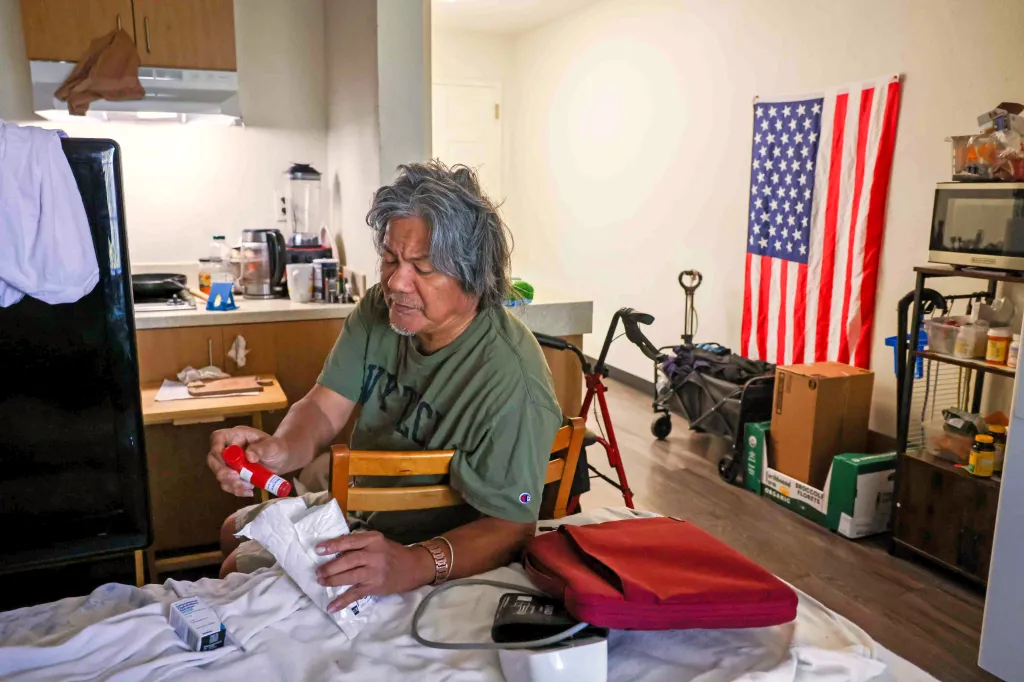
For five years, 78-year-old Hector Ocampo lived in his van in San Mateo after rising rent left him unable to afford his apartment once he retired.
Read more Hiltzik: Trump greenlights California’s dumbest water project
He parked where he could, relying on friends’ places for a shower when possible, but even those arrangements had limits.
“It was a very hard life,” Ocampo said.
One day, while parked near a Safeway, police approached him for trespassing. Instead of issuing a citation, officers connected him with services. Ocampo eventually moved into a shelter before securing permanent supportive housing at Casa Esperanza in Redwood City, where staff check on residents, organize activities and provide support as they age.
Casa Esperanza is a former Comfort Inn & Suites that San Mateo County converted into 51 apartments for formerly homeless residents. It welcomed its first residents in 2023.
San Mateo County hopes to offer that same stability to dozens more older adults by converting another hotel, this time a former Ramada Inn in South San Francisco, into 45 units of permanent supportive housing. It will open later this year to residents from shelters across the county, transforming a building that once served short-term visitors into long-term homes for older adults who have experienced homelessness.
The project will meet only a fraction of the need. County officials say 747 of the county’s 2,240 homeless residents, or a third, are 55 or older.
Supportive housing for older adults combines permanent, affordable housing with on-site services such as case management and behavioral healthcare. Providers say the model helps formerly unhoused seniors, many of whom have chronic health conditions, disabilities or mobility challenges, remain housed and live as independently as possible. The South San Francisco project is among several supportive-housing developments serving older adults in the Bay Area.
The Ramada Inn conversion comes as an increasing number of older Californians become homeless, a trend officials say reflects the widening gap between fixed retirement incomes and rapidly rising housing costs.
That gap is particularly stark in San Mateo County. The U.S. Department of Housing and Urban Development estimates the fair-market rent for a studio apartment at $2,485 a month, about $550 more than the average monthly Social Security retirement benefit of $1,935 cited by Kiplinger.
“We’ve got a problem on our hands,” said Jackie Speier, a member of the San Mateo County Board of Supervisors.
The county purchased the hotel using Homekey, a state-funded program that helps local governments convert hotels and other properties into permanent housing for people experiencing homelessness. More than 60 Homekey developments are located in the Bay Area. Speier said older adults have been particularly vulnerable as rents have climbed while Social Security and other retirement benefits have struggled to keep pace.
Read more Horoscopes July 22, 2026: Selena Gomez, engage in pursuits that broaden your perspective on life
Each of the 45 studio apartments will include a kitchenette, allowing residents to prepare meals independently. The building will also feature shared laundry facilities, common areas and on-site case management. County officials say converting existing hotels is significantly less expensive than building new housing from the ground up. About $15 million was budgeted to buy and renovate the Ramada Inn.
Chris Callandrio, chief program officer at Episcopal Community Services, which will operate the housing and provide 24-hour staffing, said renovations include grab bars, automatic stove shutoffs and other accessibility features intended to help residents remain safely independent.
“The goal is for folks to come in and age in place for as long as they choose to,” Callandrio said.
Housing is only one part of the model.
Staff trained in aging, dementia and mobility issues will provide case management, while behavioral health clinicians and therapists will be available on site. Property management teams with experience serving older adults will also support residents.
Callandrio said one of the biggest challenges after someone moves from homelessness into permanent housing isn’t finding shelter. It’s combating isolation. Studies show that factors that accompany aging — like reduced mobility and deaths of spouses and peers — can exacerbate the effects of loneliness for older adults, leading to depression and other issues.
“People experience an episode of loneliness when they move in,” he said. “They may be leaving communities they’ve built in shelters.”
To help residents build new social connections, Episcopal Community Services plans activities. Karaoke has become one of the most popular events at another senior program in San Francisco.
The organization also tracks outcomes beyond whether someone remains housed. Staff monitor medical emergencies, resident participation in activities, satisfaction surveys and how long residents stay in their apartments.
“To us, longevity is a success,” Callandrio said.
Although he moved into Casa Esperanza only in November, Ocampo said the supportive services have already changed his life.
After injuring his back and spending a month in the hospital, staff regularly checked on him as he recovered. He now uses a rollator because of weakness in his legs, but said it reassures him to know someone will knock on his door if staff haven’t seen him.
Read more Asking Eric: Her question about my husband was totally inappropriate
“I don’t want to move anywhere else,” he said.
About the Author