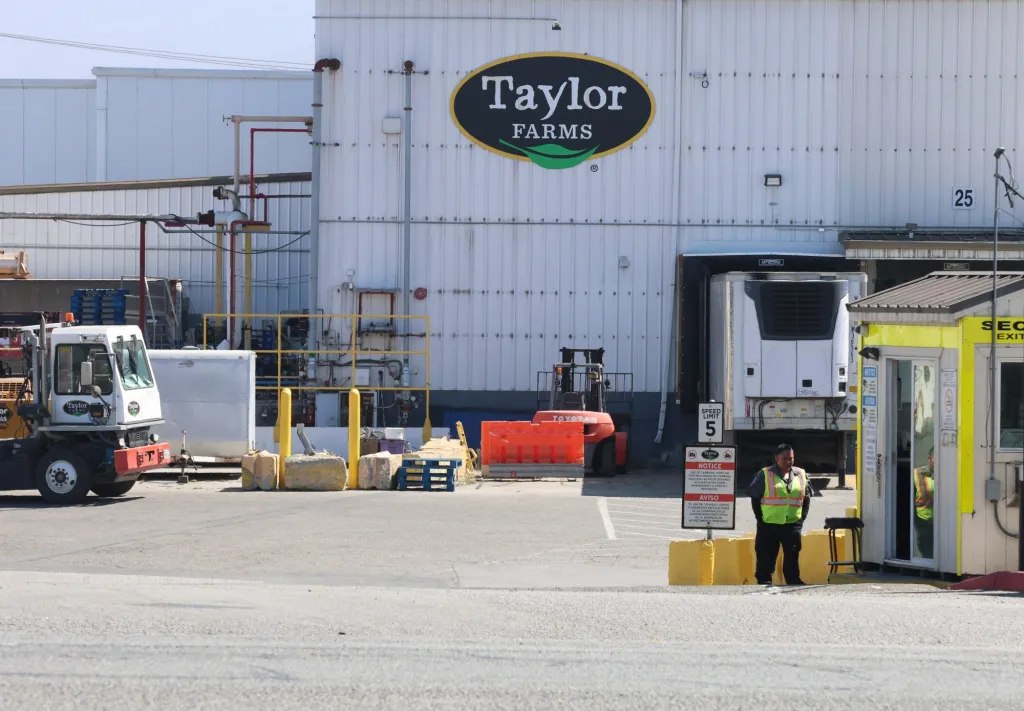
SALINAS — The source of the Cyclospora outbreak remains unclear after the Food and Drug Administration announced Sunday that tests linking the parasitic illness to iceberg lettuce from Taylor Farms were a false positive.
Read more South Bay office leasing activity hits highest level since late 2024: report
Despite the inaccurate early test results, federal health officials said Monday they remain focused on lettuce from Taylor Farms as a potential source of the multistate outbreak.
RELATED: Salinas-based Taylor Farms pulls Mexico-grown lettuce linked to Taco Bell Cyclospora outbreak
UC San Francisco professor and infectious diseases expert Peter Chin-Hong said that a false positive result is not uncommon when trying to track hard-to-detect parasites like Cyclospora.
With standard testing, which amplifies genetic material for scientists to identify in a sample, it can be difficult to pinpoint parasites like Cyclospora correctly, said Chin-Hong.
“Because it’s so sensitive, scientists have to distinguish what is true from what is background noise, which is what happened in the FDA investigation,” Chin-Hong said.
Chin-Hong said that a positive test could still be incoming given the investigation identifying Taylor Farms de Mexico lettuce being identified as a common denominator in cyclosporiasis cases.
The investigation is ongoing, according to the FDA, which still recommends consumers, restaurants and retailers in 27 states – not including California – who purchased or received recalled lettuce distributed by Taylor Fresh Foods discard it immediately.
As of Monday, no confirmed source of Cyclospora has been identified. The FDA said it will continue to collect and analyze product samples.
Taylor Farms responded to the false positive result on Sunday, saying that the FDA apologized to the company. Agency officials said there was no official apology.
Taylor Farms also said out of an abundance of caution it has completed a voluntary recall on all potentially affected product and it will continue to work with public health authorities as the ongoing outbreak investigation continues.
Chin-Hong said that while oftentimes the exact dollar amount lost through food recalls like this remains unknown, when taking into account the lost product, drop in demand, supply chain disruptions and potential for litigation, an outbreak like Cyclospora could cost a company tens of millions of dollars.
Read more How much coffee a day is safe for your heart? AHA issues statement on caffeine
“The immediate recalls cause direct financial loss from destroyed produce and lost labor productivity, and they also impact retail/grocers and restaurants,” said Tahra Goraya, president and CEO of Monterey Bay Economic Partnership. “For consumers, outbreaks can reduce confidence, plummet demand and increase medical and public health costs.”
Since May 1, 1,645 cases of cyclosporiasis, a parasitic infection which the CDC says can cause “frequent and sometimes explosive bowel movements,” have been reported across 34 states. The microscopic parasite infects food that has come in contact with human feces, most often when produce is irrigated or washed with contaminated water.
While the disease is usually not life threatening, if left untreated it may result in prolonged symptoms for more than a month. The CDC reports 141 hospitalizations and no deaths.
On Thursday, the FDA announced that in five states–Indiana, Kentucky, Michigan, Ohio and West Virginia–a common thread for 90% of cyclospora cases was “a single supplier of iceberg lettuce from Mexico used by Taco Bell locations where sick people ate before becoming ill.”
Friday, the FDA identified the single supplier as Taylor Farms de Mexico, a subsidiary of the Salinas-based Taylor Farms. Following this, Taylor Farms initiated a voluntary recall on all iceberg lettuce grown and processed in Central Mexico, distributed in 27 states.
Taco Bell also responded, stating that it “worked swiftly to voluntarily remove the product from restaurants and the affected ingredient has been removed from our supply chain nationwide.”
Taylor Farms said the supplier identified by the FDA is an independent farm that produces less than 1% of the U.S.’s iceberg lettuce supply.
Saturday, initial test results from the FDA came back positive for Cyclospora in the recalled iceberg lettuce.
Sunday, these results were declared a false positive.
Monday, the FDA said false positive results came from a rapid test used to screen for traces of Cyclospora, but a quality control check showed the positive finding was an error.
According to a statement by the FDA, “due to the complexity in detection of Cyclospora, FDA laboratory experts re-reviewed the sample results and have concluded that the finding does not represent true amplification and should be considered a false positive.”
The FDA stated that it notified Taylor Farms about the false positive results but will continue working with the company to ensure that all recalled products are still removed from the market.
Read more 13 carmakers sign up for California EV rebate initiative
The Associated Press contributed to this report.
About the Author