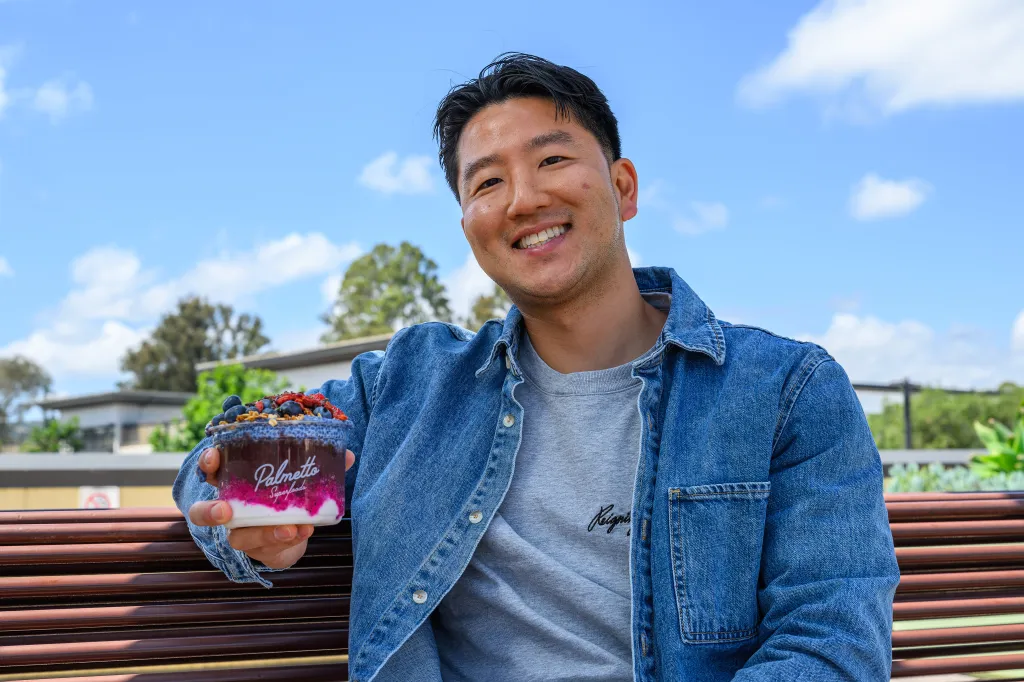
One small food stop survived a culture-changing pandemic by staying ahead of consumer and food trends. CEO and co-founder of Palmetto Superfoods Charles Lee credits his business partners and savvy earned from years in e-commerce.
Read more Read ‘The Odyssey’ with Mary Beard, not with Elon Musk
Palmetto Superfoods first opened in 2019 — right before the COVID-19 pandemic closed many resturants. It offers trendy acai berry bowls and smoothies, and now has around 20 locations, with Bay Area stores in San Francisco, Burlingame, San Jose, Palo Alto, Walnut Creek, Livermore, Mountain View, Fremont, and now Los Gatos.
Q: How did you start Palmetto Superfoods? It started through a connection with Cafe de Casa in San Francisco, right?
A: I met Amanda Moreira (co-founder Palmetto) of Cafe de Casa back in 2014 or 2015 when she opened up the cafe right next to where my office was. I was doing e-commerce in the fashion and sneakers industries near Fisherman’s Wharf, and I was going to them almost daily for breakfast and lunch. One thing that caught my attention from their menu was their acai. Their’s was something special. We had a lot of respect for each other’s businesses. One day, I had this idea that the acai could be a standalone hero. I had other ideas to do fun tropical flavors with a functional concept in mind. She thought the same. You’ve heard the cliché of love at first sight. We had that same thing, but for business.
She brought her sister Thais Moreira, and I brought in Hessam Shirmohammadi (co-founder and COO-CMO). We started back in 2019 after figuring out the menu.
We want it to be delicious, but we also want people to actually feel good about it, and not feel guilty, so we really focus on letting the fruit do the talking.
After 2019, obviously, COVID hit, but we still kept pushing through.
Q: How did you adapt during the pandemic? It was so disruptive for so many restaurants.
A: I come from e-commerce, and I brought the same strategy into food: keep it online. We try to give the customer different ways to do it. From the get-go, we set up the self-ordering kiosk and online ordering, which no one was using at the time, but when COVID hit, obviously it shifted, so we were ready for those demands. And if we’re in a mall, we emphasize that people can order ahead, or order, go about shopping and come back to pick up.
Q: Taking a step back: What is acai? Why is it a so-called superfood?
A: You can only get it in Brazil in one particular area, though there might be other smaller farms popping up around South America and a few small spots in Hawaii. Acai has a ton of antioxidants — it’s 10x or 100x of what a blueberry has. Of all the berry families, it’s what is most beneficial to us.
Amanda and Thais are from Brazil and know how to source it and produce it the right way. They know who to talk to and what farms to work with. Our eventual goal is to keep expanding in Brazil, making sure we can supply all the future stores to come. Those are all things that we think about: How do we keep up with the demand, and how do we farm and produce enough? That’s been one of the bigger challenges as we keep going.
Q: So walk me through it. How do the acai berries become the purple stuff you get in a bowl?
A: So the process is, farmers in Brazil pick it from a tree. They literally climb up a couple stories to harvest it. Then it is taken to a facility where it has to be flash frozen immediately. You have to do it within 24 hours or the berries go bad. After they’re frozen, they get shipped in blocks to us, and we take the blocks and do our formulation to blend it. That’s the product we get into the stores today. So a new batch is freshly made on a weekly basis at all the locations. And that’s also kind of why the taste is prominent, because it’s as fresh as possible.
Q: What kinds of shifts have you seen regarding people’s health-consciousness in their diets as you’ve been in this business?
A: I think it’s definitely a shift since COVID, and it’s more prominent today. People care about what they put in their body. Consumers are a lot smarter today. They worry about the consequences of the fast foods on the world and about eating heavily processed packaged foods.
I think that is why consumers gravitate to Palmetto, because it’s easily accessible. We want to be price-inclusive. We want everyone to be able to get something. We keep the price of a small bowl from us under $10 or so — and we think that’s strategically positioned so the customer can compare it to premium ice cream, coffees and bobas, which are in a similar price range.
Q: So what’s your go-to order?
A: If it’s a bowl, I start with a light layer of our coconut beach, with coconut milk, coconut cream and coconut nectar. And then I’ll do a big layer of our acai. And then do some chia pudding and some steel-cut oats, just for the textures, and the flavor combination is amazing.
Read more Trump and Mamdani to attend World Cup Final on Sunday
These days I skip the granola — even though I love our granola line. It’s fresh and made here locally in San Francisco. We work with Nana Joes for the gluten-free version too. Then I just go crazy on the dry toppings like seeds and nuts. And if I want a little bit more protein, then I will get a combination, like almond butter and our cacao hazelnut spread, which is our version of Nutella, but there’s no palm oil, just a little bit of coconut sugar, vanilla bean extract, real cacao hazelnuts and a little bit of salt. When it comes to smoothies, I’m very simple. As long as it has protein in it, just get an acai smoothie and throw in a scoop of protein.
Q: So where does acai fit into the day? Is it a meal? A snack? A dessert?
A: That’s the beauty of Palmetto, because you can enjoy it almost any time of the day, whether you’re coming in before work, or you just finished an early morning workout and want to grab something. A lot of kids go after school to get it as a snack. People do get it for dinner as a meal replacement. Our busiest points are still at lunch, but it’s fairly also busy throughout the other times. Get it when you please, when you’re craving it, or when you want a bite of it.
Q: So Palmetto Superfoods started in 2019 and now has how many locations?
A: We’re at around 20, and we’re not slowing down. I think we’ll finish the year around 30-plus locations, which is insane, because, you know, we’re at officially 19, with 20, 21, 22 and 23 all set for the coming weeks. And then we’ve got another stack of them before the summer, and more in the fall. We just opened our Los Gatos location. It’s been needed because the South Bay has been a very good, healthy market where consumers keep asking us to open more. So we are listening.
One thing we don’t shy away from is feedback — whether it’s good or bad. We always take it and see if we can always improve on it.
I still look at every single customer service email, which is insane. One of the fun ways I’ve been interacting with customers is through our rewards app. People make orders, and if there’s an issue, they’ll hit up the customer service line. I’ll always see that email, and so I will always respond to them.
Q: That seems unusual.
A: Yeah, but I always want to see what the customers think and what they want. Because that’s going to be the true telling of how we continue to succeed.
For instance, matcha has been a big thing. So this summer, we have a very big fun matcha menu coming out, and I think people will be really excited for it, with additional matcha items. It always comes down to “what are the consumers thinking?”
Q: So what’s next?
A: We have really lofty expansion plans. We’re well-established in the Bay Area, but I moved to Orange County last year to help with the expansion down here. We only have one location here, in Beverly Hills, and then we just opened one in Orange County as well. We also have plans in Texas. We just opened our Austin location. Then New York. We’re also exploring a cafe version, as well. The first one will be in Hawaii, in Oahu. We’re also going to go toward Asia, where coffee, ice cream and boba are dominant. We also have friends and family out there to help support us. We’re excited for that part of the chapter, too.
Q: What’s been the biggest surprise along this journey so far?
A: It definitely has changed how I think about work. I don’t think what I do today is work. It just feels like it’s part of my life. I never have a stressful day. I’m never worried. My mindset has been to take it day by day.
Everything I do now revolves around Palmetto, so I truly care about it. I wouldn’t feed anything to the world that I wouldn’t feed my kids. And so my kids approve. So those are the things I think about when it comes to how people should eat and live: a little bit better, so they can not worry about their later years. I think we’re just getting started.
Bio:
Age: 38
Job title: Founder, CEO
Education: UC Riverside – Psychology/ Neuroscience
Hometown: San Francisco
City of residence: SF until recently, now Irvine, CA
Family: Wife Juvina, 2 kids, Enzie (4) and Zoee (2.5), 1 dog Pucci
5 Fun Facts:
1. I always had a passion for the food industry. During my senior year at George Washington High School, I was part of a small class learning culinary arts from Mr. Ochi. That class of 25 students including my close friend Richard Lee, who is now Chef de Cuisine at Saison SF, and myself, who founded Palmetto in SF. Others have gone to work for amazing establishments such as Lazy Bear in SF and Eleven Madison Park in NY.
2. I started investing in the stock market when I was 18, and even more so right after the big 2008 financial crisis.
3. My unique work experience ranges from the fashion and sneaker industry to real estate development, tech and, now, food and beverage.
Read more Mike Oakland steps down after legendary run as St. Francis baseball, softball coach
4. I travel to get inspired. I’ve visited over 50 countries now.
5. I like to stay fit and play sports in my free time.
About the Author