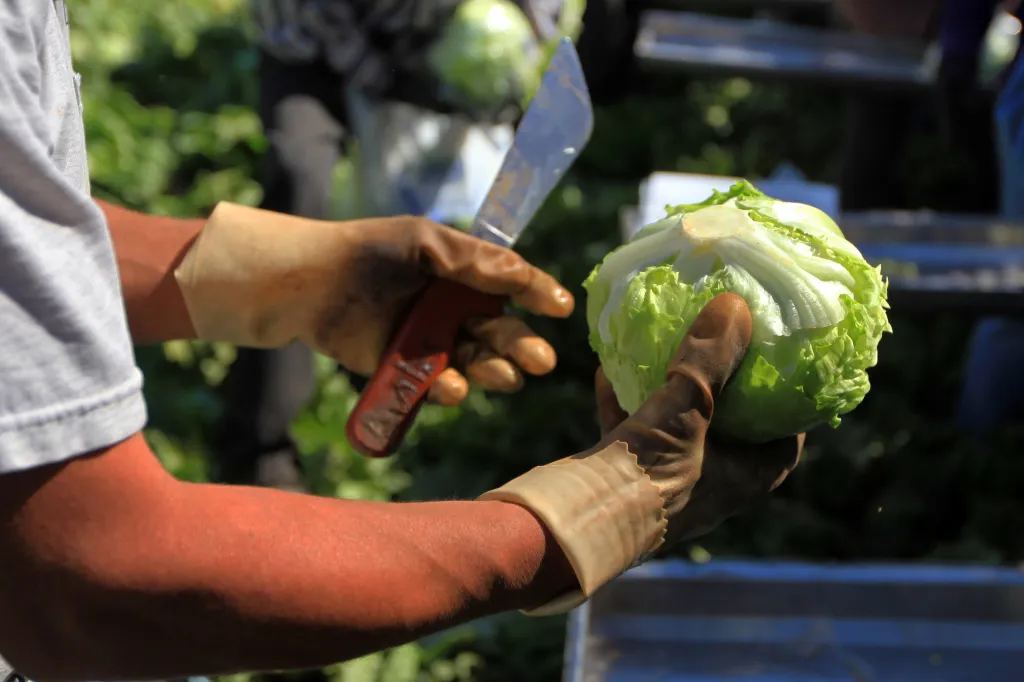
Salinas produce giant Taylor Farms said Friday its Mexican subsidiary was removing all iceberg lettuce sourced from central Mexico from the U.S. market after federal officials linked shredded lettuce served at Taco Bell restaurants to more than 1,600 confirmed cyclosporiasis cases in five states, amid a broader nationwide surge in the parasitic illness.
Read more Boat that sank off Alcatraz Island found by authorities using sonar equipment, officials say
Taco Bell said Friday it had completed the removal of “affected Taylor Farms lettuce” from its restaurants. The U.S. Food and Drug Administration has not publicly identified the supplier, saying only that its investigation converged on a single Mexican supplier used by Taco Bell locations where people ate before becoming ill.
Taylor Farms said in a Friday morning Facebook post that its Taylor Farms de Mexico subsidiary responded to information from the FDA by “voluntarily removing all iceberg lettuce sourced from central Mexico.”
Taylor Farms said the supplier identified by the FDA was an independent farm that produces less than 1% of the U.S.’s iceberg lettuce supply.
“While the FDA traceback is indicating a specific independent farm, which represents less than 1% of the U.S.’s iceberg lettuce supply, as the potential source of the outbreak, we have removed all iceberg lettuce from the region indefinitely,” the company said.
Taylor Farms said none of its branded salads or kits was associated with the outbreak and none of its branded salad kits contains iceberg lettuce.
“As a family-owned company, we are deeply concerned for those who became ill, their families, and the Americans whose trust in the safety of fresh produce has been shaken,” the company said.
Taylor Farms did not respond to Bay Area News Group’s request for additional comment beyond its public statement.
The Centers for Disease Control and Prevention has linked 1,644 confirmed infections to shredded iceberg lettuce served at Taco Bell restaurants in Michigan, Ohio, Indiana, Kentucky and West Virginia. Michigan had 1,141 cases, Ohio had 420, Indiana had 47, Kentucky had 25 and West Virginia had 11.
The reported illnesses began from May 13 through July 13. Ninety-four people have been hospitalized and no deaths have been reported.
The CDC has warned people not to eat shredded iceberg lettuce from Mexico served at Taco Bell restaurants in those states, although federal officials said not every location received the implicated product. No federal recall has been announced.
State and federal case totals differ because states may include probable illnesses and reports that have not yet been confirmed by the CDC. Michigan, for example, reported Friday that it had received more than 5,000 reports during its investigation.
No California outbreak
Dr. Peter Chin-Hong, a UC San Francisco professor and infectious disease expert, said this outbreak appears unlikely to have reached California because related illnesses probably would have surfaced by now.
“We would’ve seen it already,” Chin-Hong said.
The California Department of Public Health said Friday that the state has no current cyclosporiasis outbreak and has recorded fewer cases than it had at this point last year. California has reported one laboratory-confirmed, domestically acquired case in the CDC’s broader national surveillance count. That case has not been linked to the five-state outbreak involving shredded iceberg lettuce served at Taco Bell restaurants.
The FDA advisory applies only to shredded iceberg lettuce from Mexico served at Taco Bell restaurants in the five affected states. It does not implicate California-grown lettuce.
Chin-Hong said the size and reach of modern food companies can allow contamination from a single source to affect people across a wide area.
“You can have thousands of people affected at the same time from a contaminated lot,” Chin-Hong said.
The Taco Bell-linked illnesses are part of a broader increase in cyclosporiasis under investigation nationally. The CDC has confirmed more than 1,600 domestically acquired cases since May 1 and is reviewing more than 5,100 other reports to determine whether they meet the federal definition.
If enough of those reports are confirmed, this year’s total would surpass the 4,703 cases reported in 2019, the previous annual high.
How Cyclospora spreads
Cyclospora is a microscopic parasite that causes an intestinal illness called cyclosporiasis. It can cause severe watery diarrhea, loss of appetite, weight loss, stomach cramps, bloating, nausea and fatigue.
Symptoms usually begin about a week after infection but can appear anywhere from two days to two weeks or more after exposure. Without treatment, the illness can last more than a month and symptoms may disappear before returning.
The infection can be treated with the antibiotic trimethoprim-sulfamethoxazole, commonly sold under the brand names Bactrim and Septra, according to the CDC.
Unlike E. coli, which can be spread through livestock manure, Cyclospora is believed to infect only humans. It spreads when food or water becomes contaminated with human feces, according to the CDC..
Read more Ryan Fox matches major championship record with a 62 in the British Open
The parasite must mature in the environment for days or weeks before becoming infectious, making direct person-to-person transmission unlikely. Its ability to mature under warm environmental conditions helps explain why U.S. cases generally rise during spring and summer.
Chin-Hong described Cyclospora as a “hardy” parasite that can be difficult to remove from produce.
Outbreaks are often associated with fruits and vegetables that are difficult to clean thoroughly, including lettuce and raspberries, he said. Washing produce can reduce contamination but does not guarantee the parasite will be removed. Cooking produce to at least 158 degrees kills Cyclospora, according to federal health officials.
Tracing the source can also be difficult. By the time symptoms appear, people may struggle to remember everything they ate during the previous two weeks. Diagnosing cyclosporiasis requires specialized laboratory testing that is not always included in routine stool tests.
Historically, U.S. outbreaks have often been linked to imported produce, although the parasite has also been found on domestically grown fruits and vegetables. Contamination can occur through water, sewage or handling during growing, harvesting or processing, according to the CDC.
Taylor Farms’ outbreak history
Taylor Farms has previously figured in federal foodborne illness investigations.
In 2013, restaurant-associated cyclosporiasis illnesses in Iowa and Nebraska were linked to salad mix from Taylor Farms de Mexico in Guanajuato, according to the CDC. The broader investigation involved several simultaneous outbreaks and 631 reported illnesses across 25 states and New York City, some tied to other produce sources.
In 2024, federal officials linked recalled yellow onions distributed by Taylor Farms and served at McDonald’s restaurants to an E. coli outbreak involving 104 people in 14 states. Thirty-four people were hospitalized and one died.
The outbreak strain was not found in onion or environmental samples, but the FDA concluded that epidemiological and traceback evidence identified the onions as the likely source.
Taylor Farms, founded in Salinas in 1995, employs about 20,000 people and operates more than 30 production facilities globally, according to the company. It produces salad blends, kits, vegetable mixes and snack packs.
California growers defend safeguards
The Grower-Shipper Association of Central California said Friday that California-grown leafy greens are not covered by the federal warnings.
“California leafy greens are produced under the most stringent food safety standards in the nation,” the Salinas-based trade association said.
The association pointed to federal food-safety requirements and mandatory state audits of leafy-green farms whose products are distributed commercially.
The California Leafy Green Products Handler Marketing Agreement said lettuce produced in California and Arizona — which make up 90% of the nation’s consumption — are subject to “comprehensive, science-based food safety practices.”
Outbreaks remain rare compared with the enormous amount of produce sold and do not necessarily demonstrate that a company mishandled food, said Jose Pablo Dundore-Arias, a Cal State Monterey Bay associate professor specializing in food safety and plant pathology.
Dundore-Arias compared the risk to infections in hospitals, which can occur despite extensive safeguards and sterile practices. Warmer environmental conditions may also help the parasite mature, he said, although investigators have not determined how the lettuce involved in this outbreak became contaminated.
Jeanne Merrill, executive director of UC Berkeley’s Berkeley Food Institute, said strong federal oversight and well-funded state and local health departments are essential to limiting the number and severity of foodborne illness outbreaks.
“You need nimble and well-resourced public health agencies to be able to respond, in addition to having a federal foodborne illness monitoring program … that’s looking for all the pathogens, including Cyclospora,” Merrill said.
Merrill noted that the CDC narrowed reporting requirements in July 2025 for its FoodNet system for tracking food-borne pathogens, making it optional instead of mandatory for health authorities to report Cyclospora and several other pathogens.
FoodNet conducts active surveillance across areas representing about 16% of the U.S. population and is intended primarily to measure disease prevalence and long-term trends, not detect individual outbreaks. The agency’s announcement of the change at the time said “other surveillance systems monitor for infection,” and that limiting reporting would allow FoodNet staff to “prioritize core activities.”
The CDC did not respond Friday to a request for additional comment about Merrill’s concerns.
Merrill said she worries the outbreak could discourage people from eating fruits and vegetables.
“We should be increasing access to healthy and sustainably grown food,” she said.
Read more Why Adames will be instrumental to SF Giants’ second-half hopes
About the Author