State lawmakers are hoping that a big investment in county election offices will help reveal results faster this November.
But local registrars, though grateful for the additional funding, caution that expectations of speedy election results in the fall should be cooled.
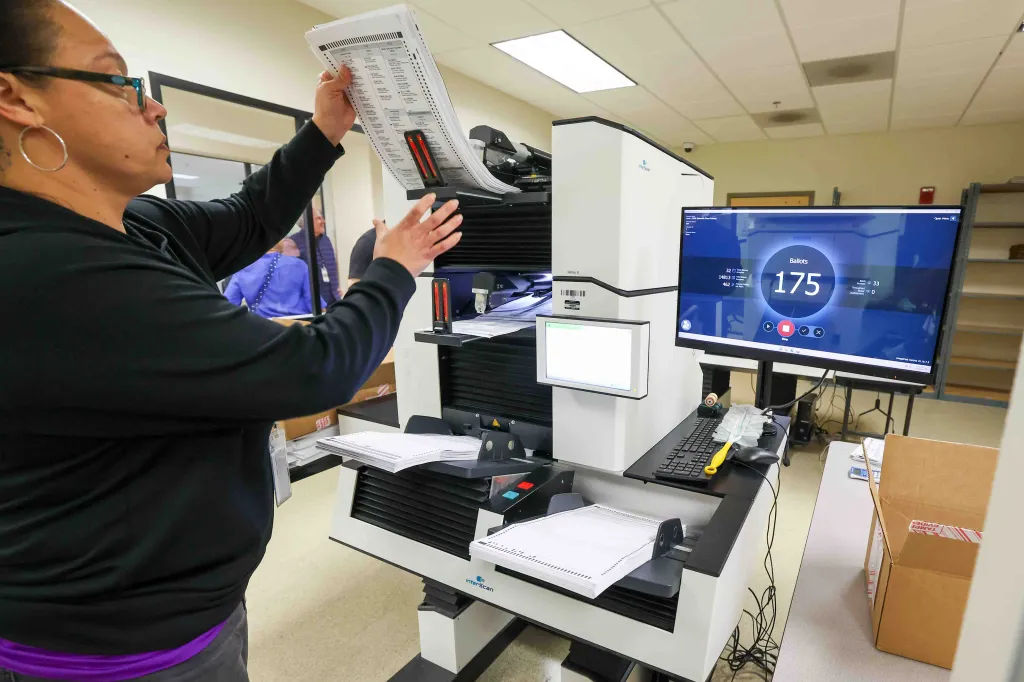
A lot has been said — and critiqued — about how California conducts its elections, especially when it comes to how long it takes for winners to be declared. In California, every registered voter is mailed a ballot. As long as a voter’s ballot is postmarked on or before Election Day and received by the county elections office within a week of Election Day, it still counts.
But a large swath of voters will often return their ballots on Election Day, causing bottlenecks that delay results.
“Many voters like to wait to Election Day or closer to Election Day to become an informed voter,” said San Mateo County Assistant Chief Elections Officer Jim Irizarry. “If a voter takes the time to vote, we want to make sure it gets counted.”
That’s why, as part of the $350 billion budget deal inked in late June, California lawmakers earmarked $40 million to speed up the process.
That includes a $29 million funding pool for county election offices to hire staff and purchase voting equipment.
An additional $5 million is available for counties to conduct voter outreach and education, in hopes of encouraging people to return their ballots ahead of the Nov. 3 Election Day so they can be tallied earlier.
Another $5 million for voter outreach and education will be sent to the Secretary of State’s Office, and $750,000 will be available for California’s Office of Emergency Services to track misinformation and disinformation ahead of Election Day, according to the budget bill approved by the legislature.
“The state allocating funds for elections is absolutely necessary and needed with respect to hiring additional staff and equipment to speed the process,” Irizarry said. “It’s designed for accuracy over speed by all means. The election system is based on people and technology, so any resources that go to those two foundations of the election process is helpful.”
While election advocates have called this a timely investment, Santa Clara County Registrar of Voters Matt Moreles said expectations should be tempered when it comes to just how helpful this funding will be come November.
“While any additional election funding is helpful and appreciated, given the proximity to the November election, it is unlikely that major changes to our processes will be possible in time to be fully implemented and thoroughly tested before we need to begin training staff and ramping up operations,” Moreles said.
“We are currently evaluating the best way to utilize this funding to both implement quick and attainable process improvements for this year’s November general election, as well as to make investments for more meaningful and sustainable changes for the 2028 presidential elections. Likely, we will be able to move most swiftly on voter education and outreach efforts for the November election, while more complex hardware and technology upgrades would follow next year.”
Contra Costa County Registrar of Voters Kristin B. Connelly said any investment in election administration is a positive step. But, she added, the impact of the new state funding will depend on when funds become available.
Read more Gilroy Garlic Festival selling out fast
“Funding from the State is always welcome, and once we know how much our county will be receiving in this one-time allocation, we will put it to its best use,” Connelly said. “It’s important for the public to remember that this funding is one-time, and it’s coming to us after our plans have been made for November. We will do everything we can to encourage the voters of Contra Costa to vote early, which enables us to include a greater share of vote-by-mail returns in the first results we release when the polls close on Election Day. I look forward to engaging with members of the state Legislature about how ongoing and reliable funding for space and staffing could facilitate the speed of counting ballots.”
What’s being doled out by the state is a one-time expenditure, and it’s not clear yet just how much money each county will receive. Until it’s understood how much each county will receive, the Riverside County Registrar of Voters “cannot determine … how those funds may ultimately be allocated,” said spokesperson Elizabeth Florer.
Orange County Registrar of Voters Bob Page’s team is reviewing options for how to spend the county’s share of the $34 million pie in a way that can be sustained in future years, he said.
Still, Irizarry said funding for voter education could have a more immediate impact.
“Resources are important in voter education and outreach,” Irizarry said.
Kim Alexander, president of the California Voter Foundation, a nonpartisan group that works to improve the state’s election process, said state lawmakers made a “substantial commitment” to counties ahead of the 2026 election.
“While the amount budgeted is less than we had recommended, it still represents a sizable investment that prioritizes timely election results,” Alexander said. The organization had pushed lawmakers to include nearly $90 million in the budget to speed up the vote-counting process.
Page said Orange County’s vote-counting process has improved in major elections over recent years.
Page’s office processed more than 95% of accepted ballots within the first week following the primary election in June — and the same was true for the 2024 presidential general election.
That’s one day better than the office’s performance in the 2022 statewide primary and two days better than the 2020 presidential election, he said.
Generally, Los Angeles County hits similar, if not higher, processing rates during major elections despite a much larger voting base, Sanchez said. For the June 2 primary election, the registrar’s office processed close to 98% of ballots within the first week.
Irizarry said that in spite of the challenges posed by late-arriving ballots, his county has done a respectable job of turning results quickly, with a “sizeable portion” of ballots processed within the first day after the election and 90% by the end of the week.
“I think we do pretty good, given the statutory requirements,” Irizarry said. “We want to make sure ballots are accurately counted.”
Read more Redwood City man charged with two attempted sexual assaults
Staff writers Jeff Horseman and Linh Tat contributed to this report.
About the Author