SANTA CRUZ — Of all the perils faced by marine life in the Monterey Bay, domoic acid is one of the most mysterious. The toxin, produced by algal blooms, attacks animals’ brains and can cause disorientation and death in seabirds and California sea lions. In fact, Alfred Hitchcock’s film “The Birds” was inspired by an article he read in the Sentinel about seabirds that were likely exposed to the toxin on the Santa Cruz County coast. Domoic acid can even affect humans who eat exposed seafood, causing amnesic shellfish poisoning.
Read more Feds to decide fate of $2 billion California plan to fund Medi-Cal
Researchers found high concentrations of the algae that produces domoic acid, Pseudo-nitzschia, in the Monterey Bay in the spring. Despite the spike, marine mammal and bird rescue agencies haven’t seen a surge in symptoms indicating domoic acid exposure.
RELATED: What’s killing seabirds along California’s coast? ‘Just one damn thing after another’
Raphael Kudela, a distinguished professor at UC Santa Cruz, studies harmful algal blooms, including Pseudo-nitzschia and domoic acid in the Monterey Bay. His lab conducts weekly tests for the algae at the end of the Santa Cruz Wharf. In late May, Kudela said, he saw the highest concentration of the algae he had seen in 20 years of sampling. He added that it is also a high year for domoic acid concentrations, but not quite as high as previous peaks.
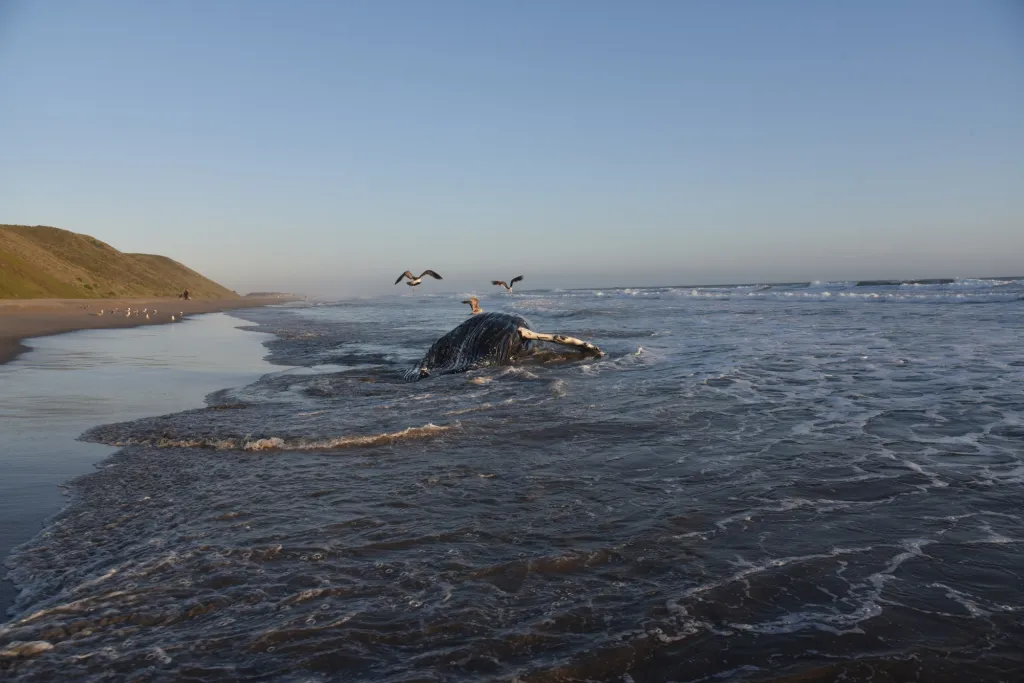
In early June, two juvenile humpback whales were stranded along the coast of Monterey Bay. Domoic acid was detected in both animals, which otherwise appeared healthy. The Long Marine Lab at UC Santa Cruz reported that domoic acid exposure was a contributing cause in the deaths of both whales. Kudela said it’s possible that the whales ran into a particularly dense patch of the algae and ate exposed fish, which could have been a contributing factor.
Then, on June 26, the California Department of Fish and Wildlife announced that elevated levels of domoic acid had been found in northern anchovies and Pacific sardines. The department enacted restrictions on the commercial take of both fish species for human consumption in the Monterey Bay, from the area south of Pigeon Point in San Mateo County to a line due west from Point Lobos in Monterey County.
Despite the considerable concentrations of algae in the bay and in small ocean fish, rescue agencies reported that not many animals have shown symptoms of domoic acid exposure this year. The Marine Mammal Center told the Sentinel that since high levels of algae were measured in the late spring and early summer, concentrations have dropped. The center also has not seen an uptick in sea lions with neurological symptoms, such as disorientation, excessive scratching or head bobbing, in recent months. Similarly, Native Animal Rescue in Aptos reported that though they have seen a surge in seabird deaths, none have tested positive for domoic acid. International Bird Rescue, based in San Francisco, also said that despite high algae levels earlier this summer, not many symptoms have been observed in seabirds.
Read more Here’s why this tribute act will be a top draw at major music festival
Marine birds and mammals are often exposed to domoic acid through their diet. Small fish consume algae, and with it, domoic acid. The toxin doesn’t seem to cause death in fish, Kudela noted, though the effects are still being studied. The exposed fish might experience disorientation, but usually survive long enough to be eaten by birds or sea lions. Depending on how much exposure the larger animals get through their food, they may experience slight disorientation to profound brain damage. The toxin can cause the animals to have difficulty feeding, swimming or flying. Some animals can recover if they find a food source that hasn’t been exposed, but others succumb to the toxin.
Kudela and his lab hope to better understand why the algae produces domoic acid and what influences large blooms, to create better predictive models. Right now, he said, the lab can estimate where the algae blob is going to be a few days ahead of time, enough to give a heads up to marine mammal stranding networks and commercial aquaculture operations. Because the blooms are so unpredictable, the priority is to limit human and animal exposure.
There’s still much to be discovered. Scientists don’t yet understand why the algae produces domoic acid. It’s been demonstrated that the algae produces the toxin when running out of silica, a nutrient they use to make a rigid cell wall, but we still don’t know why those processes are linked, Kudela said.
The blooms themselves are also unpredictable. Kudela said that this year’s high concentration of algae was likely a result of cold, nutrient rich water upwelling to the surface during warm conditions and getting trapped at the ocean’s surface. An influx of nutrients, either from upwelling or runoff from fertilizer or wastewater treatment, is one factor that is known to contribute to large blooms. Various varieties of algae may also react differently to climate change.
While researchers understand general patterns, there are some factors that are not yet understood. The conditions in the Monterey Bay aren’t particularly extreme, Kudela said, so it remains unclear why the largest bloom ever recorded sprung up this year.
Read more Data center could sprout on empty chunk of land at prime San Jose site
About the Author