By Amanda Hess, New York Times
ST. LOUIS — The first time Bernadine Barber saw the word “tradwife,” it was being used to describe her. She was not yet 30, she had three children, and her Instagram content promoting traditional gender roles was gaining a following. She had started going by Bernadine Bluntly online, a name to reflect how plainly she spoke her truth. Now she’d been drafted to represent the tradwife at a 2019 right-wing event in Miami. The digital flyer drew her in an anime style, in a modest dress with an infant pressed to her chest.
Read more Horoscopes September 27, 2026: Jenna Ortega, don’t waste time
“I don’t care if I ever go onstage again,” Bluntly announced after speaking against women’s suffrage and promoting wifely submission. “My kids are my first priority! My husband is my first priority!”
Onstage and online, Bluntly argued the tradwife’s cause with passionate intensity. But privately, “I was already going back and forth about leaving my marriage,” she told me recently. Soon she would have six children, 141,000 YouTube subscribers, friends at Evie Magazine and Turning Point USA, and a commitment to an ideology that she now says made her suffer.
“You’re told that if you really love God, then you submit to your husband, you fight for your marriage, you forgive no matter what, and you stay for the kids,” she said. “It’s honestly a miracle of God that I woke up and got out.”
Last year, Bluntly left her husband and got a restraining order against him. A Missouri court found that she had proved allegations of domestic violence, and forbade him to come within 300 feet of her. (In a court filing, he denied committing “any act or pattern of domestic violence.”) After their divorce was finalized this past spring, she posted a video titled “What I Got Wrong About the Trad Movement.” It signaled a new life for her, and a new job: as an ex-tradwife influencer, warning women away from what she now describes as a program of spiritual manipulation and covert marital abuse.
“I no longer believe in extreme gender roles, especially when they’re wrapped in spiritual language,” she says in the video.
“If any belief system creates a power imbalance that puts women or anyone in a position of fear, isolation or total dependence, I reject it,” she says, adding, “If my past content contributed to that, I am so genuinely sorry.”
The “tradwife,” cutesy internet shorthand for “traditional wife,” is a new word for an old archetype. Her modern icon is Hannah Neeleman, the Mormon homesteader who has nine children, 10.3 million Instagram followers and ultrarich in-laws, and who sells protein powders under the name Ballerina Farm. Her posts swept onto our feeds alongside a pronatalist administration and a reactionary social front, announcing the rebranding of a fundamentalist feminine role.
But social media trends don’t last forever, and the trad trend is showing its cracks. Nara Smith, the 24-year-old home cook known for her purred voice-overs and high-femme look (4.8 million followers on Instagram), recently went on the “Call Her Daddy” podcast in jeans, described her marriage as equal and denied that “tradwife” had ever described her. Neeleman told New York Magazine, “If there’s things that I’m sharing that people think are actually doing harm to our sex, then OK, let me take the feedback.”
As support for President Donald Trump wanes, so does his movement’s user-generated content. “Between MAGA cracking and the tradwife trend coming to an end, we’re going to start seeing women come out of these marriages,” said Tia Levings, the author of the 2024 memoir “A Well-Trained Wife,” who once maintained a homemaking blog and now identifies as an “ex-evangelical trad cult survivor.”
Leaving tradlife is not as easy as Smith might make it seem. The typical tradwife may be “four, five, six babies in,” Levings said, and yoked to a doctrine of constant childbearing and subservience to men. “And oh, by the way, their husbands bought in, and they’re not going to let them out,” she said.
I met Bluntly in July in St. Louis, where she had moved from her marital home, which she described as an off-grid tiny house in rural Missouri. Her children, who range in age from 1 to 14, were away with her ex-husband under a shared custody arrangement, so we had a long lunch at a sidewalk cafe near her new house. She ordered an Italian soda and wore a plaid pleated skirt and a scoop-neck tank under a white oxford shirt, thrift-store finds she said she would not have been allowed to wear before: the skirt cut too high, the tank top too low. She looked as if she could have been an Instagram baddie in another life.
“Is it OK if I pray for you real quick?” Bluntly asked. I told her I’d just come from visiting a relative in the hospital, and she asked the Lord to bless me with a peace that passes understanding. When she talked about her former tradwife content, she grimaced at her own lines. When she spoke about her actual tradwife life, she cried.
A year ago, “I was just trying to fight for my own mind,” she said. Now her independent city life “feels like it’s a dream.” She had just posted a video of herself on Instagram, a slapstick number where she struggles to hang a boxing bag she’d snagged secondhand on Facebook. I asked to see the algorithmic suggestions Instagram was serving to her, and she showed me a grid of women engaged in martial arts.
“I’ve been using this time to strengthen myself,” she said — boxing, tennis, target practice, articles, studies, books. She changed her Instagram bio to “DV survivor and mama of 6.” She joined a club for women in business, started attending a Presbyterian church and met her new best friend at the DMV. “I read two books this month, cover to cover. I don’t remember the last time that happened,” she said. Since the divorce, she added, “I’ve been slowly shifting what I believe, and finally having the space and the freedom to do that.”
I had begun following Bluntly on Instagram a few years earlier, fascinated by the niche she occupied in the right-wing ecosystem. You would not find her posting idealized cooking or farmwork videos. Instead, she positioned herself as one of the trad movement’s ideological foot soldiers, knitting the down-home feminine aesthetic to a political project, one she expressed through commentary designed to pop off online. She had a modest but notable audience, somewhere on the continuum between influencer and influenced.
As she preached submission, her presence was so confident, her affect so wryly disobedient, that cognitive dissonance was built into her brand. God had given her a face made for reaction videos. “My lips are full, my eyes are big, my eyebrows are thick — you can read every emotion on my face,” she said. “I used to get in trouble for that as a kid.”
What she concealed — from her online audience, and often from herself — was her own misery.
‘Being erased’
Before Bluntly was a wife, she was a girl. She was born in the Philippines in 1990, the fourth of five children. Her mother died when Bluntly was 4 years old, and her father — the son of a U.S. serviceman — relocated the family to the United States when she was 7. “Between my mom dying and moving to America, the culture shock and the language barrier, I was very shy,” she said. “I kept to myself.” Her father, she said, was volatile and absent. She moved frequently, following her eldest sister’s naval postings before settling in Texas. At 16, she read evangelical pastor Rick Warren’s “The Purpose Driven Life,” and then, she said, “I gave my life to Jesus.”
At 17, she met a boy at a church housed in a local movie theater. When he left for a charismatic Pentecostal church, where he would become a youth pastor, she followed. And when her father became physically abusive, she said, she moved in with the youth pastor’s family. The church preached against premarital cohabitation, and its pressure mounted. One day, a visitor calling himself a prophet announced that he foresaw her becoming the youth pastor’s wife, and an exultant congregation praised God. By 20 she was engaged, and by 21 married. “I didn’t have time to process it,” she said. “It was like, God said.”
Bluntly got an associate degree in early childhood education, hoping to move abroad to do missionary work and teach English to children. She enrolled in Texas A&M University but dropped out after a semester. “I got married and had my first baby instead,” she said. She began writing and recording Christian spoken-word poetry, and soon she was getting gigs at cafes and banquets that brought a glint of national attention. But as her marriage progressed, “my dreams, my passions, my talents were absolutely secondary.”
“And then, increasingly, they were framed as an obstacle,” she continued. “I felt like I was being erased.”
In 2017, two babies in, she read “Lies Women Believe: And the Truth that Sets Them Free” by Christian author Nancy DeMoss Wolgemuth. It promotes an ideology of “biblical womanhood” as the key to a life of abundance and bliss. The cover features a red apple nipped by a sinful bite. Bluntly came to believe that any problem in a marriage was a woman’s to fix.
Read more Stanford apologizes for using AI to swap race, gender of a student in its marketing materials
“I thought, Oh, maybe that’s what I’m doing wrong,” Bluntly said. “Maybe me pursuing my dreams and trying to use my talents outside the home is what’s causing the problems.” Even as she resigned herself to domesticity, she “still needed a creative outlet,” she said. Digital content presented “a happy medium,” a way to work from home and a social outlet for her increasingly isolated life; after a series of arguments over where they ought to attend church, she and her husband had stopped going. For a time, she posted family vlogs, but “somewhere along the way I started talking about politics, too,” she said, “and it was the political content that really took off.”
Her breakout post was in support of Brett Kavanaugh’s nomination to the Supreme Court. “It’s so ironic now,” she said ruefully. “That was my introduction to actually having a voice, or influence.” She branded herself Bernadine Bluntly and opened an online storefront selling $25 shirts that read “R.I.P. Feminism.” Although she rarely shared details of her family online, “my lifestyle — of having had so many kids — was speaking for itself,” she said.
As tradwife influencers were fruitful and multiplied, she created a digital course for young women, Simply Smitten, in which she dangled the keys to courting godly men. Her husband posted his own content, advising men on how to become a “strong patriarch” who can mold a “sweet tradwife who happily ‘fills your gut and empties your balls,’ as the saying goes.”
Soon, Bluntly’s influence became the family business, and her modest and inconsistent online income — it brought in an average of $2,500 a month, she said — was stretched to meet the family’s needs. “Everything was configured to make it justifiable,” she said. “I’m leading people, but I’m doing it under my husband’s approval and headship, so it’s OK. I’m making money, I’m the breadwinner, but that’s OK because he’s acting as my CEO. I work for the family.” Meanwhile, she said, “I was constantly getting pregnant again.”
She felt trapped, she said, in a psychological and spiritual cage. Traditional wives who try to leave “are not just feeling that they’re disappointing their husbands,” Bluntly said, adding: “It’s worse than that. They are directly disobeying God.” And the expectation to have as many children as possible keeps them physically in the home, and the movement. “If you get pregnant, you’re less likely to leave, less likely to fight back,” she said. “You’re a lot more vulnerable.”
When I asked how that reproductive dynamic influenced her own marriage, she wiped away tears. “I love my kids,” she said. “I would probably go through everything all over again just to have all six of them here.”
In 2024, Bluntly tapped a rich vein of online attention by posting a series of reaction videos in which she pokes fun at a feminist perspective on gendered work. She imagines a feminist woman saying that “anything men can do, we can do better,” and then superimposes her face over clips of men engaged in strenuous blue-collar labor. As they wield chain saws and drill oil, Bluntly performs shocked admiration. Then she delivers her tagline: “Reject delusions. Embrace gender differences.”
The series racked up 20 million views. And yet Bluntly’s sublimation of her ambition into a glorification of masculine work failed to produce the family harmony and personal fulfillment she had hoped it would.
One day in May 2025, she found herself in that off-grid home with no church, no local support system and six children. She believed that she had done everything to try to make her marriage work, she said, but “I felt like I was dying inside.” Her youngest son was 4 months old. She was not permitted, she said, to walk down the gravel path leading to the highway on her own. But she had a phone.
Bluntly remembers shutting herself into an office structure installed behind the house, a space where she often disappeared to film her videos. Instead, she called the police station, asked for a patrol car to be sent and sneaked down the path to meet it. At the precinct, she shakily filled out the paperwork to file an order of protection against her husband as he texted her phone, asking where she was. “I just jumped, and I wasn’t sure how I was going to land,” she said.
Her two older sisters drove through the night to pick up Bluntly and her children and brought them to a motel in Gainesville, Missouri. That summer, they bounced around between hotels, a shelter, the house of a friend. One night, as she prepared to put her kids into a packed car, she paused to film another green-screen video in front of a hotel wall.
“I didn’t have the mental bandwidth to be like, ‘What do I believe?’” she said. “I had to keep doing what works. I had to keep doing what pays. That was how I was going to feed my kids.”
Bluntly now shares physical custody with her ex-husband. (Joan Meier, the director of the National Family Violence Law Center at the George Washington University Law School, said that family court judges often give little weight to allegations of domestic violence in custody decisions and have penalized mothers for moving away with the children.) Pursuant to their divorce arrangement, she pays him $235 a month in child support out of her influencer wages. “If I didn’t have social media,” she said, “I would have nothing.”
Mothers of reinvention
When a tradwife influencer divorces, she explodes the very basis of her content business. But she still has a platform, one that she can jump from into a new world of content where she’ll find other women on a similar path. Like Jennie Gage, who calls herself “Ex MAGA, Ex Mormon, Ex Tradwife” and now makes a living decoding the offerings of Neeleman and Smith for her 391,000 TikTok followers. And Alice Llani, who serves 855,000 TikTok followers winking instructional videos with captions like “how to make up for 6 years no job experience or education due to being a tradwife @19 no borax no glue.”
Enitza Templeton, a 43-year-old Colorado mother of four, identifies as a “former tradwife” and “current baddie” to her 247,000 TikTok followers. When she became disillusioned with her own tradlife, Templeton created an Instagram account called Sweet by the Slice. “I thought that if I could post my life online and make it look beautiful, then maybe I would believe that my life was beautiful,” she said. But social media also gave her a window into her unlived life — and a future income stream she could use to escape. Scrolling Instagram “was a huge shock,” Templeton said, adding, “I saw other mothers that had five children, and they were single moms, and I was like: You can do that?”
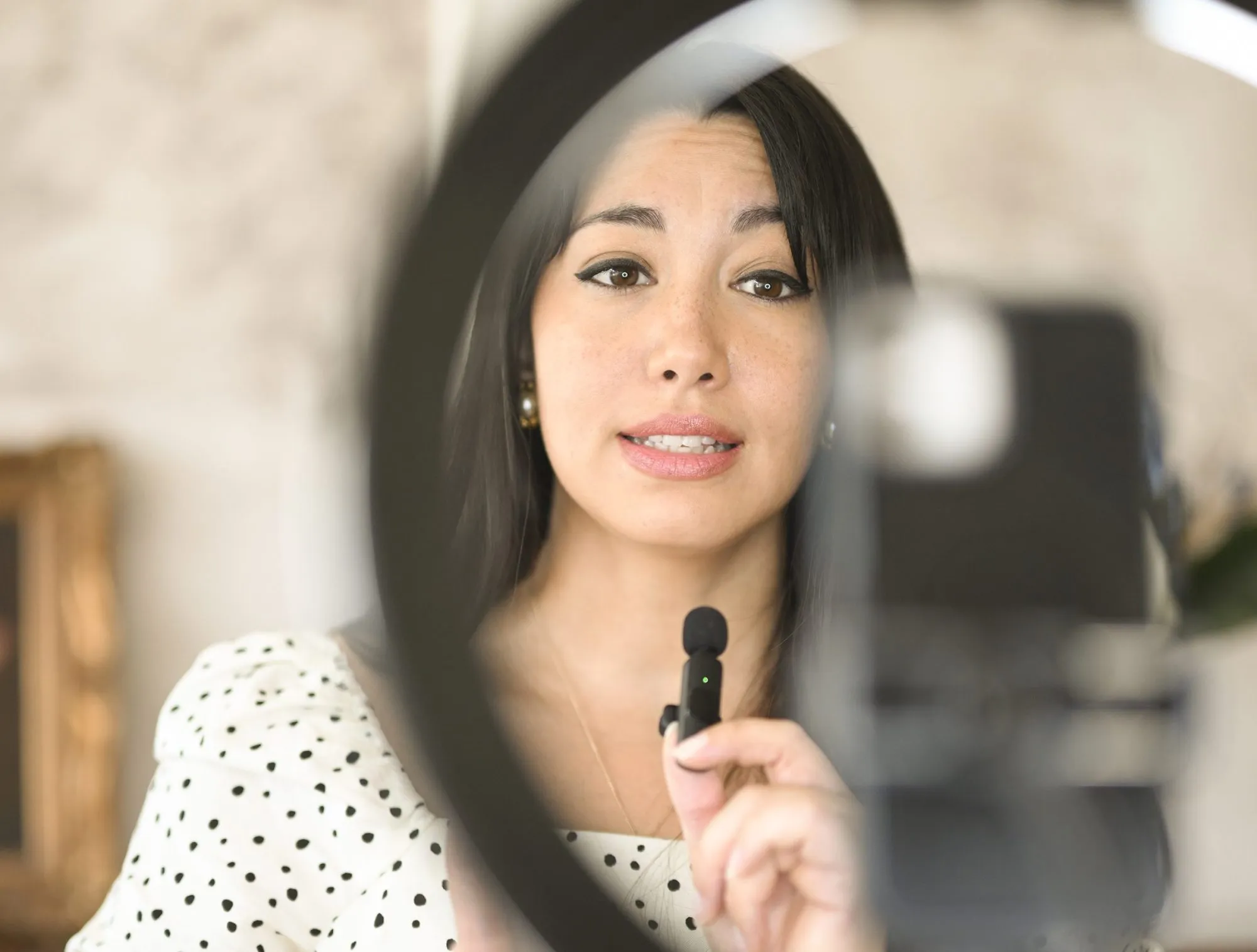
When Bluntly and I left the cafe, she drove me to my hotel in her minivan, a hand-me-down gift from a friend. She kicked a tennis racket aside to make room in the passenger seat. The next day, I joined her at a studio owned by a woman she’d met through her businesswomen’s club; it’s the kind of place designed for girls’ nights, with a jewelry bar and floral photo backdrop. Bluntly set up her phone on a tripod, flipped her hair twice and filmed two videos using TikTok’s built-in teleprompter feature. Both were warnings: against husbands who demand secrecy in marriage, and against communities that uphold an image of family values over women’s and children’s lives.
Bluntly is still finding her footing as a post-trad influencer. She shares lifestyle content about women-owned businesses in St. Louis and speaks about her Filipino heritage in a way she never did before. She regrets preaching marriage as the height of a woman’s ambitions, but she’s grateful that many of her former mentees are still following along. “I’ve been there, I’ve done that, I’ve got the T-shirt, the restraining order and the divorce,” Bluntly said. “Now I’m like, Just be careful.”
Bluntly has received support online from women who are questioning their own beliefs — and skepticism from those who feel her reversal is too little, too late. “It’s a legitimate criticism; some of it is deserved,” Bluntly said. “I have apologized for the things I’ve said, and I will continue to do that, and take ownership of it.” She is still disentangling a lifetime of patriarchal influence, and she isn’t sure where she’ll land politically. “I feel like so many of the things that I thought ‘the left’ or ‘feminists’ believed were not accurate,” she said. “They’re attacking systems and ways of doing things, not just all men.”
She is not dating yet, but “if God has it in the cards for me,” she said, she’d like to someday. “I don’t know if I’m having more kids,” she added. “I think I might — I kind of want — I’d be open to one more.”
In time, she said, she hopes her social presence can “help bring awareness and education on abuse and coercion, specifically within religious or traditional circles.”
“I just have this weird kind of desire,” she said, “to make my life count for something.”
Read more Asking Eric: All his first dates say he’s nice but there’s no spark. What can he do?
This article originally appeared in The New York Times.
About the Author