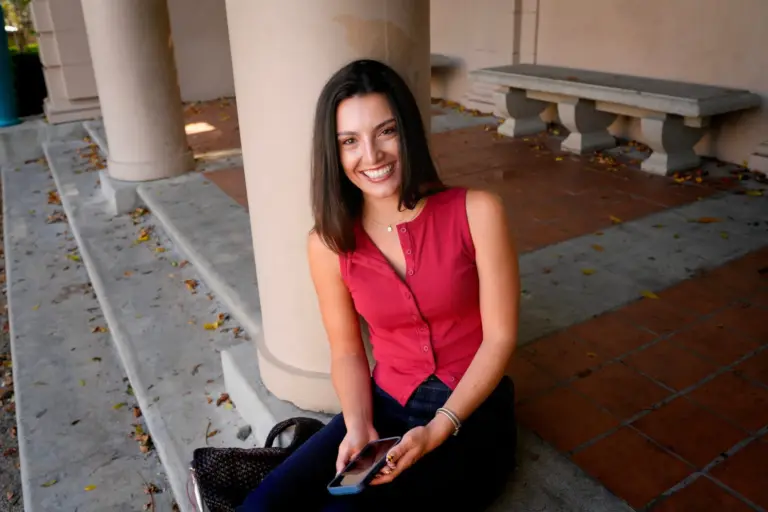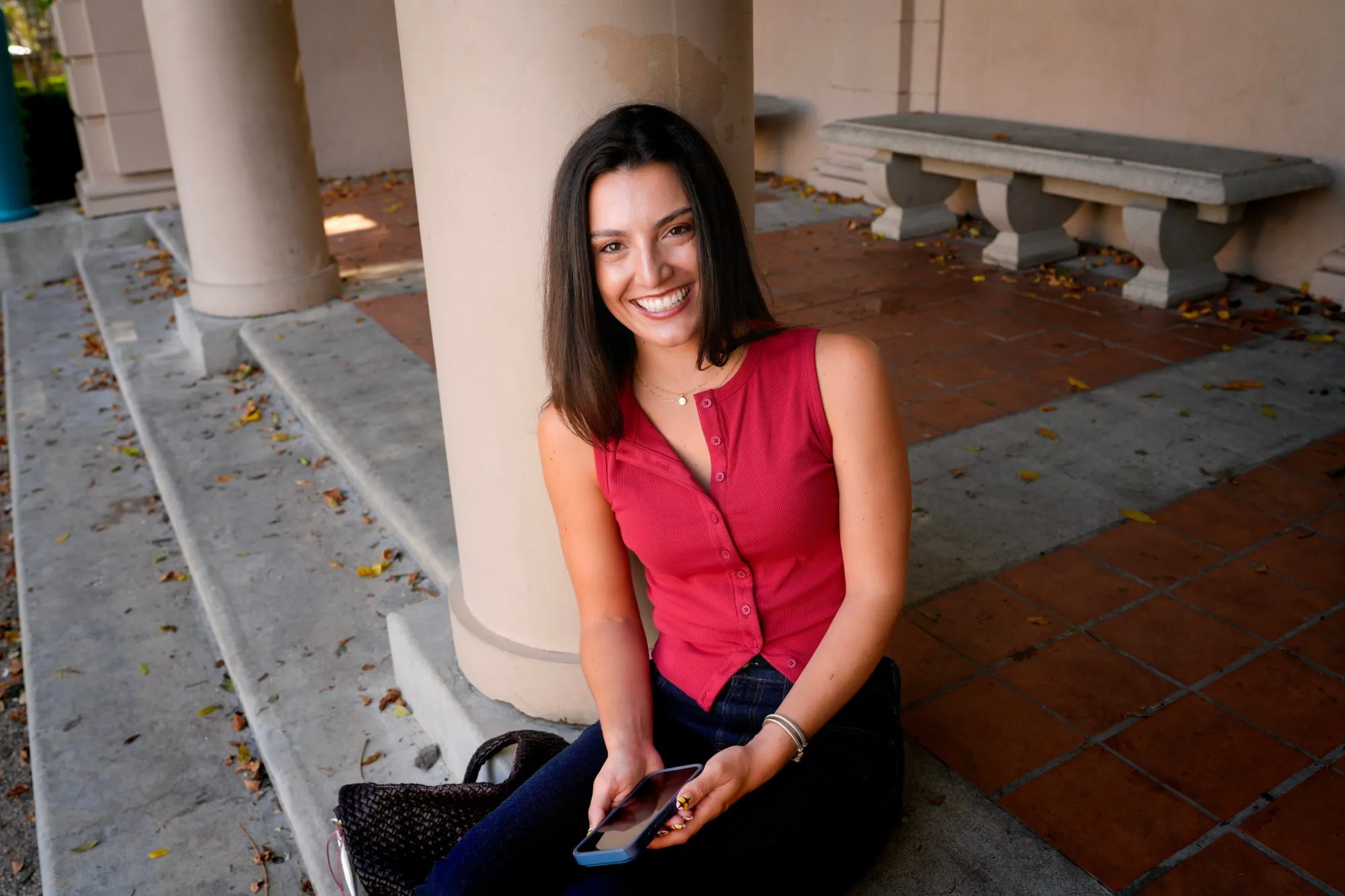
When she’s bored, Maeve O’Connor will scroll through Bumble or Hinge, sometimes with the intention of going on a date. Sometimes, just window shopping. But because “nobody actually likes Hinge,” she decided to try something different.
Read more Young but good: How Castro Valley has taken next step in flag football
On an August afternoon, O’Connor downloaded a new dating app called Known, which launched in San Diego this summer. When she opened it, her phone rang. “I’m not a real person, so just be honest,” a voice said on the other side of the line.
O’Connor, 26, squirmed in her seat. Instead of filling out a profile, users are interviewed by an AI matchmaker. The idea is to skip the paralyzing carousel of swiping and let an algorithm choose your perfect partner.
Known is coming on the scene as young adults are increasingly struggling with how to date and the social interaction required to meet potential partners. Among the half dozen users interviewed by the San Diego Union-Tribune, some have expressed unease about the dystopian premise of looking for love though an AI chatbot. Others have been remarkably candid with the platform, handing over intimate details about their desires in the hope that an algorithm can identify the person they are most compatible with.
But whatever they think of the technology itself, they are all confronting the same question: Does Known actually work?
During a 30-minute interview, the chatbot asked O’Connor about her vacation plans this summer and what she liked (and didn’t) about her ex. Some users will discuss their relationship to God. Others will share in depth details about their kinks.
The chatbot is analyzing more than just answers, it also takes note of your hesitation, inflection and laughter to really gauge who you are.
At the end of the call, Known claims to know you better than you may know yourself — thus the name.
Since launching in July, thousands of San Diegans have signed up for the app.
Erica Solberg has been using an AI dating app called Known that launched in San Diego this summer. The AI matchmaker interviews singles to find their “perfect pair,” then they pay the $15 fee to meet them.
Celeste Amadon is Known’s 22-year-old co-founder and CEO. She was raised in Seattle’s tech scene by two parents who work in venture capital, watching them raise hundreds of millions of dollars for companies chasing modern-day problems.
So as she saw AI investment surge, Amadon decided to tackle the biggest problem her friends were facing: finding love.
“All of my friends are on dating apps,” she said, “but very few of them are actually going on dates.”
Amadon blames the perverse incentives of traditional dating apps, which she says profit when people stay single.
“Dating apps stopped being about meeting people and started being about optimizing yourself for the market,” Amadon says, pointing to the ironic economics of Hinge’s “rose jail” — a phenomenon where some of your best matches are kept behind a paywall.
“I’m declaring a dating state of emergency in San Diego,” Amadon said at the app’s launch party in August. She handed out flyers that diagnosed San Diego men with Peter Pan syndrome — the phenomenon where men never grow up or settle down — and the paradox of choice caused by dating apps.
During Known’s debut at Foxhill Manor, singles dressed for the Hamptons-white theme took photos next to a poster that read “San Diego is full of hot people doing nothing about it.”
And to the poster’s point, there were a lot more selfies taken at the singles party than phone numbers swapped. “It’s ingrained for men not to approach women anymore,” said Dalton Boll, a San Diego DJ who attended the party.
The launch party felt like “a junior high dance,” said Wes Evans, a 26-year-old photographer, describing how many of his friends were “too petrified” to approach the women at the party.
The advent of Known was in part inspired by this “generation of young men who have never approached women in real life, but feel really rejected by women because the (traditional) apps were designed not to work,” Amadon said.
In the decade since Tinder and Hinge came to the app store, an arms race has emerged around perfecting profiles: One app ranks your most attractive photos, another uses AI to generate more flattering ones, and a third, aptly named RizzGPT, will write your opening messages for you — assuming, of course, someone finds you attractive enough to open them.
“We’re seeing a substantial group of young adults who are single and not even really trying to date. They’re burnt out on the apps,” said Amanda Gesselman, a social-developmental psychologist at the Kinsey Institute at Indiana University, who has spent a career studying this exact phenomenon. “You’re constantly swiping, trying to start conversations, watching them fizzle out, and then going right back to swiping again.”
Known’s answer is to skip the profile altogether — the app’s tagline is “swipeless dating.”
“Do you have time to chat right now?” the bot asked O’Connor. “Let’s start with a few simple things first.” The bot started with the basics: her job, her hobbies.
Eventually they were talking about how she’s not religious but maybe a little “woo-woo” spiritual — and while she probably wouldn’t align with a Republican, she’d be interested in dating a guy who looks like the skinny, tattooed lead singer of the musical act Role Model, Tucker Harrington Pillsbury.
Read more Affordable homes near San Jose train hub land key state-linked funding
After 30 minutes, the bot summarized her life in a few sentences: “You come across as the kind of person who actually shows up, someone whose Saturdays are made for surfing and slow coffee.” The bot went on, sycophantically summarizing San Diego stereotypes — optimistic, loves sunshine, likes to go on walks.
The bot said her match would be someone who is “empathetic and listens.”
“Are you serious?” laughed Lucy Baker, O’Connor’s friend who overheard the phone call with the matchmaker. She rolled her eyes. “Doesn’t everyone want someone who listens?”
O’Connor hung up the phone, uploaded six photos of herself and waited — or actually, worried.
She didn’t feel like Known really knew her by the end of the call — she wanted to call back and explain what she meant — but it was too late.
The AI transcript was being summarized and sent to the algorithm to, in theory, filter for a man in San Diego who surfs, walks and listens.
Amadon pushed back and said the agent was better equipped to gauge the “je ne sais quoi” of a person through the voice interview than a typical dating profile would.
“When writing stuff down, you naturally filter yourself,” Amadon said. “A phone call is more authentic.”
At the Known launch party, a few men shared how they told their AI matchmaker what bra size they imagine their future girlfriends would have.
“I think people are overly transparent with these chatbots,” Amadon said. “You find out a good deal about the people talking in 25 minutes.”
Though O’Connor’s initial interview was in July, she has yet to be matched by the app. Amadon said that’s by design; Known is not going to set you up with someone you’re not compatible with.
But the U-T spoke to a San Diego single who had been matched.
A few weeks ago, Erica Solberg, a 32-year-old marketing executive in San Diego, remembered waking up one morning to a notification from Known.
The app showed her a 40-year-old man who worked in real estate. Scrolling through his profile, she saw a man who frequently travels to luxurious destinations. She imagined a world where they went to baseball games on weeknights and spent Sundays at car shows.
To her friends, Solberg called him “Gaslamp Guy.” San Diego natives know the type: the West Coast finance bro—loafers, unbuttoned button-ups, Ray-Bans, and a Padres hat. If she decided to go on the date, it would cost both singles $15 — “the cost of a cocktail,” Amadon said.
From there, Known took over the logistics. It coordinated a time for the date, chose the restaurant and made the reservation. The two people wouldn’t be able to message each other until the morning of the date.
On the day of her date, Solberg watched from across the street as “Gaslamp Guy” pulled up to the Little Italy restaurant in a 1994 Porsche.
“I’d probably have swiped left on him on Hinge,” she said, “but we actually had a lot in common.”
On paper, Gaslamp Guy matched a lot of her criteria. “The conversation was good, I really liked the restaurant, but nothing really happened after, so I probably won’t follow up,” she said.
There was also the fact that he still lived with his ex.
All of this, she then shared with her AI matchmaker after the date. These post-dinner debriefs are a clever way to gather more data: The AI matchmaker uses what you say about your date — and what your date says about you — to refine your profiles for the next match.
Her next match, “Mr. Mountaineer,” turned out to be very different from her first date.
Last Wednesday, she arrived at Part Time Lover, a Hillcrest spot with a reputation to match its name, and found a 6-foot, brown-eyed man waiting for her. “He had this quiet confidence,” she said, blushing.
The conversation ran four hours — 7 to 11 p.m. — ranging from favorite restaurants to a recent rock-climbing trip that had ended, memorably, with him falling 30 feet down a cliff face.
“I was like, ‘You’re not convincing me to pick up this hobby at all,’” she said, laughing. But he did persuade her to go on a second date.
Solberg told the AI matchmaker about the successful first date that led to a second. She also had a post-date debrief with a single friend and after telling her about Mr. Mountaineer, “she’s signing up, too,” Solberg said.
Read more Students Against Period Poverty holding care package party at Milpitas Library
About the Author