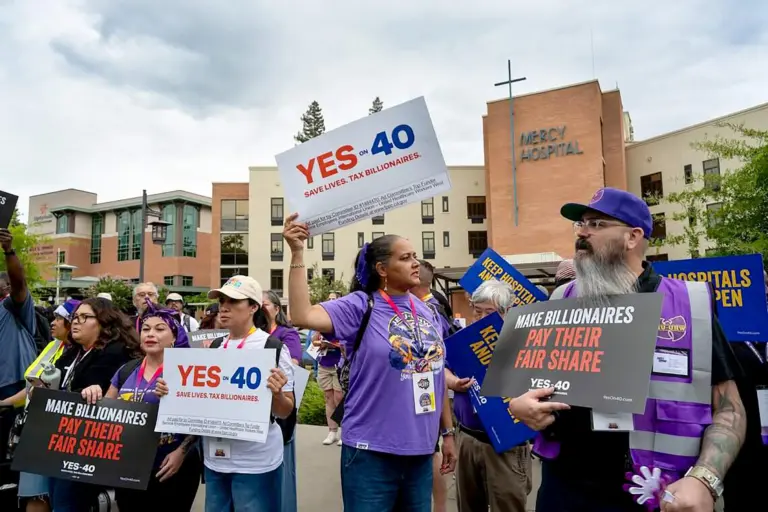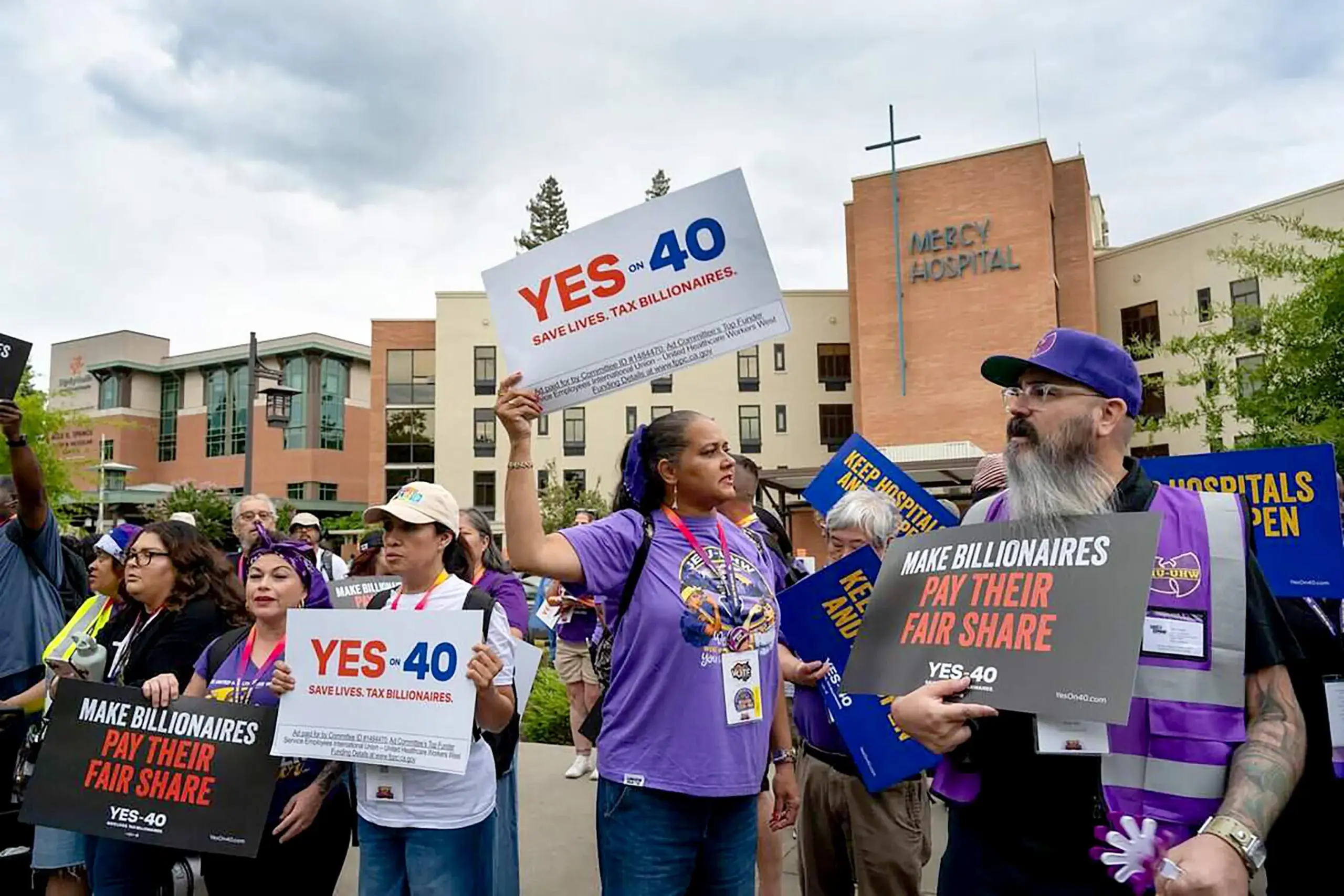
Successive waves of federal cuts to California’s safety net are hitting our shores — and hospitals.
Read more Beloved indie film and TV star stuns fans by praising Trump and Elon Musk
H.R. 1 (aka the “One Big Beautiful Bill Act”), the spending plan written by House Republicans and signed into law last year by President Donald Trump, included the largest reductions in U.S. history to food assistance and health care programs. Its intentionally punitive and retaliatory cuts to California’s Medicaid program, Medi-Cal, are projected to cost the state billions of dollars per year and lead to more than a million Californians losing access to health care.
In the Bay Area, these cuts are becoming painful.
As our news organization documented this month, the number of uninsured people in emergency rooms at Santa Clara Valley Healthcare and Alameda Health System has spiked year over year.
Those county-run systems expect to collectively lose more than a billion dollars annually. Notably, while our systems and residents are scrambling to survive, rural America is receiving a $50 billion lifeline from House Republicans and President Trump to protect their health care systems.
Proposition 40 was written to prop up this state’s safety net in the face of these devastating cuts.
However, this measure is the wrong solution to a real problem.
We advise California voters to reject short-sighted, self-sabotaging Proposition 40.
And we recommend they reject equally myopic Propositions 41 and 42 — countermeasures that would not only nullify the billionaires tax but senselessly shackle the state’s fiscal future.
Killing Golden Goose
Proposition 40 risks long-term pain for short-term gain. It’s the ballot equivalent of eating your seed corn.
Here’s how it would work:
Proposition 40 would impose a one-time 5% levy on the net worth of billionaires who were residents of California on January 1. The tax would be due next year, but the state’s 250 or so billionaires could spread the payments out over five years.
Ninety percent of the revenues raised — estimated anywhere between $40 billion to $100 billion, depending on the expert — would fund health care services. The rest would go toward education and food assistance and administration.
What distinguishes this tax isn’t just that it’s targeting a very base of extremely high-net worth individuals but also that it applies retroactively and taxes wealth, not income.
Wealth taxes are unpopular with many economists, including liberal ones, for several reasons:
They can force the sale of productive assets (e.g. stock shares, patents, copyrights, farmland, etc). They’re difficult to administer because determining the value of some intangible assets, unlike income, is more art than a science. And most injuriously, they can encourage capital flight, especially when executed by a state acting alone.
To be sure, the capital hasn’t fled California yet, but the capitalists have been.
Founders of some of Silicon Valley’s largest companies, including Sergey Brin, Larry Page, Peter Thiel, Mark Zuckerberg and Travis Kalanick, have changed their residencies or announced plans to cut ties with the state in one way or another.
What makes Proposition 40 so dangerously self-destructive is California’s extraordinary dependence upon taxing high-income earners. Over the last two decades, the top 1% of earners have paid approximately 45% of the state’s income taxes.
For that reason, the state’s most respected, nonpartisan authority on policy, the Legislative Analyst’s Office, forecasts short-term benefits but long-term costs:
California will “probably collect tens of billions of dollars from the wealth tax,” according to the LAO. But those gains would likely be temporary.
Read more Atherton surges to top spot for U.S. house prices, breaking 8-figure median
That’s because the LAO worries that “billionaires may respond to a new wealth tax in ways that reduce their income tax payments. For example, some billionaires may decide to leave California. The income taxes they currently pay to the state also would go away.”
In fact, the LAO projects that billionaires leaving the state would reduce the state’s General Fund revenues by “less than a billion per year.”
But the union that pushed this proposition — Services Employees International Union-United Healthcare Workers West — wants to gamble.
Its leaders created this to help themselves first and foremost, even at the expense of their typical allies. Opposition to this proposition includes the California Teachers Association, the Association of California School Administrators and the California Professional Firefighters, among several other public and private sector unions. These unions know they’ll suffer when the state’s General Fund takes a hit.
Even the liberal governor of this state is fiercely opposed.
“We can’t let a single advocacy organization, however well-intentioned, write the state’s tax code on its own terms,” said Gov. Gavin Newsom.
We couldn’t agree more.
Self-shackling
To counter Proposition 40, Building a Better California — a political action committee formed earlier this year and backed by Silicon Valley billionaires including Sergey Brin, Vinod Khosla and Eric Scmidt — created two countermeasures, Propositions 41 and 42.
If either Proposition 41 or 42 receives more votes than Proposition 40, the billionaires tax won’t take effect.
The problem is that these two propositions would do far more than nullify the billionaires tax. They would tie the hands of the state far into the future in ways we cannot abide.
Proposition 41
This initiative’s requirement for more audits could be valuable. It would mandate that the State Auditor scrutinize special taxes before they appear on the ballot as well as ongoing programs funded by special taxes. The LAO sees possible savings if the auditor’s recommendations are followed.
However, the problem with Proposition 41 is its second provision. It would prevent any new special taxes from being excluded from the “Gann Limit” — a strict state spending cap enacted in 1979. That means that voters could approve a new tax to address a pressing public need, only to discover that the state cannot spend the money it collects without being constrained by a constitutional limit written half a century ago.
California has changed radically since the 1970s. And its fiscal rules must leave the state with the flexibility to address issues voters of the era never had to deal with — six-figure college costs, seven-figure mortgages and 13-figure wildfire costs.
The state must not surrender its future freedom of action to defeat a single, one-time tax proposal.
Proposition 42
This initiative would prohibit the state from taxing retroactively. And it would permanently ban the state from any new taxes on ownership of financial assets or other personal properties — think stocks, bonds, intellectual property, artwork, etc.
Taxes on wealth are rarely ideal, and our opposition to Proposition 40 reflects that.
However, we are witnessing an explosion of inequality, and the unpredictable course of AI’s development risks supercharging the gap between the haves and have-nots. Joint Venture Silicon Valley’s latest research shows that 78% of Bay Area residents are concerned AI will increase economic inequality.
Proposition 42 was written by this tech boom’s beneficiaries, who are now among the wealthiest humans in history. If this initiative had limited itself to nullifying Proposition 40, we could have supported it. However, amid this era’s technology- and climate-induced uncertainty, California must keep its options open.
Proposition 42 would needlessly and recklessly narrow them.
Reject Propositions 40, 41 and 42.
Editor’s note: To read our recommendations for the most important races and measures on Bay Area voters’ ballots, please visit mercurynews.com/endorsements.
Read more Thunder, lightning may accompany first big post-summer storm
About the Author