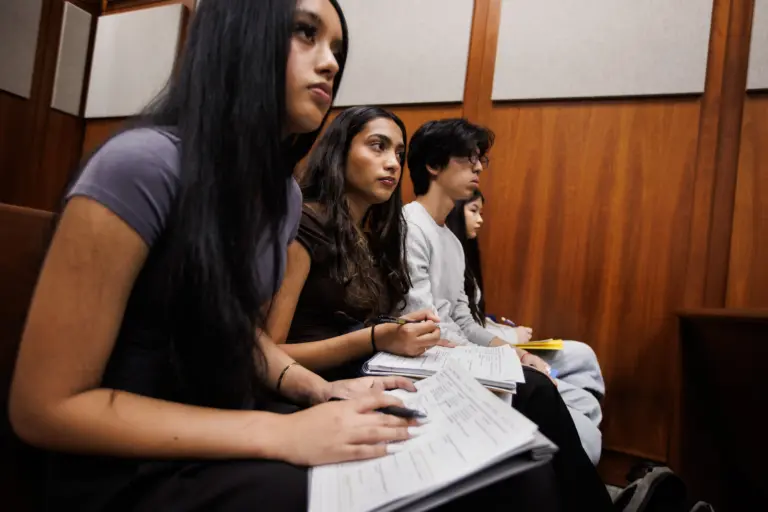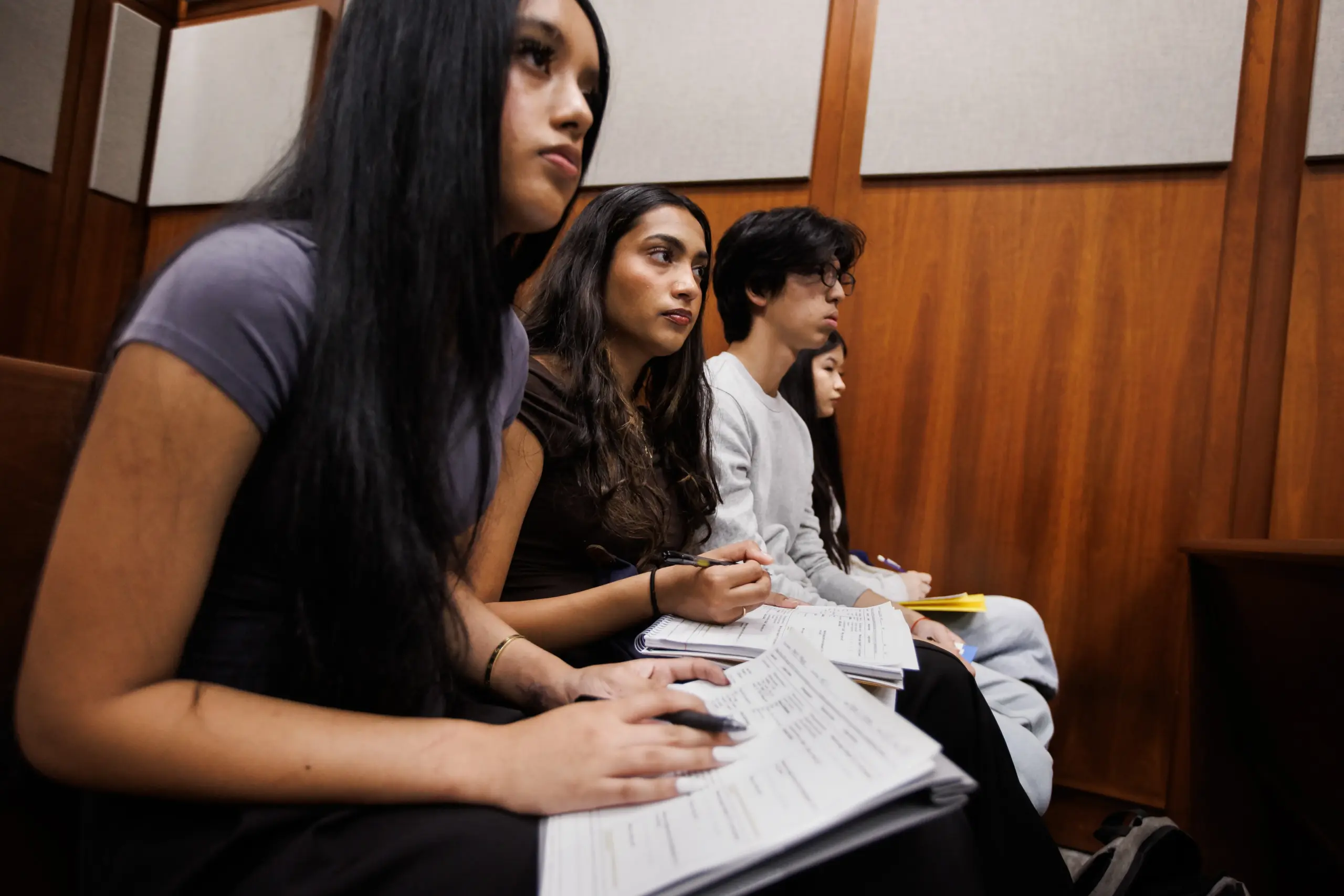
SAN JOSE – Ariana Corbu sat in court recently, feverishly taking notes and filling out forms watching a criminal defendant get arraigned. Santa Clara County Superior Court Judge Hector Ramon set the man’s bail and then worked through the rest of the afternoon calendar.
Read more Fatal Monte Sereno house fire classified as accidental
Corbu observed every statement Ramon made as he assessed bail for criminal defendants that day, watching for the judge’s tone and general courtesy to the attorneys and incarcerated men.
She was soon joined by Ian Gao, Ishani Manral, and Apurva Tadimeti in the gallery, all standing out by virtue of the fact that they were watching arraignment court on a Friday right after school, the fact they are not yet old enough to vote, and, perhaps more striking, by their ease and comfort in the environment.
This was not a one-time excursion for any class. It technically has nothing to do with schoolwork.
This is a job they carved out for themselves, taking lessons and advice from adult legal observers, attorneys, and judges like Ramon. Despite most court proceedings being open to the public, save for select scenarios like juvenile cases, Gao said that was once lost on him and many of his peers.
“Normalizing court watching is crucial because observing court is a constitutional right,” Gao said in an interview.
The four South Bay students are part of Justice For All, a court-watching endeavor they started as freshmen and sophomores — Corbu at Evergreen Valley High, and the other three at Leland High — to get acclimated to what was going on in the halls of justice, or as is the case in San Jose, the Hall of Justice.
“In conversations with peers, many didn’t know court proceedings are open to the public, or felt courtrooms were foreign and intimidating,” Corbu said. “We decided to visit the courtroom ourselves, which showed us that high school students interested in law can step foot into the courtroom.”
Their presence has not gone unnoticed.
“Minors voluntarily taking interest in the local justice system — them participating civically rather than just simply learning about it in a textbook — is so impressive,” said Hugo Meza, a deputy district attorney working in his office’s community prosecution unit.
“I hadn’t met any lawyers until I started looking into law school,” he said. “For them to already get to be in a courtroom and meet prosecutors, defense attorneys, judges, staff, victim advocates, I thought it made a potential career in public service or interest in the law more accessible.”
The students are not merely watching. Taking inspiration and guidance from established civil rights organizations, they collect data on trends and tendencies, with a keen eye on whether certain people or groups are treated unfairly or differently from the average defendant. Their self-created court forms, which are later fed into a spreadsheet, log observations including key statements made, bail decisions, whether a non-English speaker was able to get an interpreter, and whether a hearing carried a respectful tone between parties.
The student observers then give their opinion about whether a judge was lenient or strict — and must explain their rationale — and apply that same analysis to whether they believe their presence made a difference in how a proceeding went.
All of that goes toward tracking court trends and compiling judicial profiles over time. The latter remains a work in progress, but their observations have yielded articles that attest to shortcomings revolving around language barriers for defendants, racial disparities in who gets pretrial release, and the criminal justice system’s general struggles with fairly addressing mental illness and the neurodivergent.
“Speech, debate, mock trial, and youth government don’t fully touch on the real judicial system,” Tadimeti said. “A lot of what we’ve observed in the system isn’t something that’s blatantly obvious that you could maybe claim would be unjust … I feel like the tone is really important: I’ve been in instances where I’ve heard the judge call a woman ‘lady’ multiple times in kind of an arrogant tone, which seems a little demeaning.”
It’s all added up to a two-year crash course for the group.
“It removed the fear and stigma of courtrooms, helped us pick up complex legal terminology, and exposed us to critical trial observations,” Tadimeti said.
Brett Hammon, a deputy public defender who specializes in litigation involving the Racial Justice Act — a 2021 law aimed at invalidating prosecutions provably tainted by bias — is credited with helping the students design the observation forms so they can uniformly chart their data. Besides noting their interest in equity issues, he said the sight of them in some courtrooms, sometimes as the only non-attorneys in the gallery, is invaluable.
Read more Three arrested in separate alleged gang-related stabbings in San Jose
“Just their presence in the courtroom is beneficial,” Hammon said. “It just reminds everyone involved in the courtroom that there is a real public interest in ensuring fair treatment of the accused. Being a good civic person, to be able to consume and understand the news and current events, to know a little bit about the justice system … is also a huge plus.”
Not wanting to limit their efforts to their tight-knit group, the students registered Justice For All as a nonprofit organization. By leveraging a robust website and social media presence, they have helped other students in the Bay Area and beyond open up their own chapters.
Justice For All now boasts a national network of over 350 students, extending as far as Dallas and New York City, with an internship program and more than 3,000 court cases under their purview. They have received commendations from the San Jose City Council and Congress, the latter via Rep. Sam Liccardo.
Manral said the program embodies how students can affect things long before their prospective legal careers officially get going, something all four have voiced interest in pursuing.
“Injustices only happen in empty courtrooms,” Manral said, citing a motto that has become a de facto mission statement for many court-watching organizations. “Not only do (students) get to see the courtroom for themselves and dip their toe into the legal system, but in a worst-case scenario, if something egregiously bad happens in the courtroom, they’re there to document it.”
“I think having a large audience does make a difference to the judge because they know that there’s people watching them and they will be held accountable if something were to happen,” she said.
Raj Jayadev, director of the civil-rights group Silicon Valley De-Bug, a prominent court-watching outfit in the South Bay, was another mentor for the student founders and said he is heartened by their initiative.
“I think it’s a really bold thing to do because courts are so intimidating. It doesn’t really feel like your place unless you’re a lawyer, or you have a court date, or you’re a court actor,” Jayadev said. “To have the courage to say, ‘No, these are public institutions, I can be here,’ to do that at their age when there are self-imposed limitations a lot of us have when we’re younger … is a powerful instinct.”
Ramon welcomes the additional observation. He has taken an interest in the core four, and on multiple occasions after the court calendar has finished, holds an impromptu question-and-answer session with them. On that Friday afternoon in late August, he asked them to name their “dream schools” for college.
“These courtrooms do not belong to the judges. They don’t belong to the lawyers. They belong to you,” Ramon told this news organization.
Like other adults who have encountered student court-watchers, he sees them as a cause for optimism.
“They’ll be able to imagine themselves … playing these roles, whether it be as an attorney or as a judge,” Ramon said. “It demonstrates, besides their initiative, that there’s a hunger throughout our country for this kind of engagement. Our young people are not folks that are just sitting at home on their computers, on their phones, disengaged. They actually want to get out there and do something that they consider important and useful.”
For Gao, he hopes that their work is as eye-opening for his peers as it has been for him, and points to how their program leverages the idea of strength in numbers.
“I’ll be perfectly honest. I, like many people, did not know you’re allowed to go to court. I grew up in China where it wasn’t even conceivable that you could participate in the political system,” he said. “Doing it as a group makes it less daunting, and doing it more and more makes it less and less daunting. People are going to look at you a little weirdly, but then you realize when you sit down, you’re just like everyone else, there to watch.”
About the Author